
By: Alexander Charles (SSP’26), Admissions & Alumni Fellow

As millions of fans tuned in to cheer for their national teams during the 2026 FIFA World Cup, Security Studies Program (SSP) alumnus Sina Nemazi (SSP’24) was focused on a different goal: protecting the international tournament from cyber attacks.
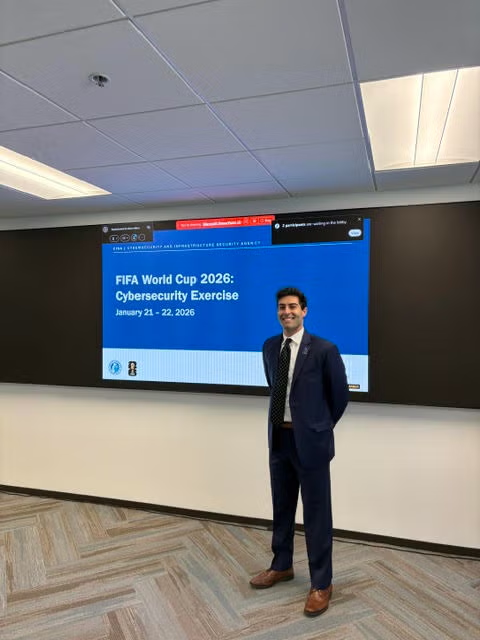
As a cybersecurity manager for FIFA, Nemazi led efforts to safeguard the digital infrastructure behind one of the world’s largest sporting events. His responsibilities ranged from protecting FIFA’s internal systems and corporate networks to cybersecurity coordination and response with host cities. At the same time, Nemazi interfaced with the FBI, CISA, the Canadian Centre for Cyber Security and Mexico’s National Cyber Incident Response Center, facilitating cross-border cyber threat intelligence sharing while developing FIFA’s trusted partnerships, coordination mechanisms and operational playbooks that will strengthen cybersecurity cooperation for future international sporting events.

Nemazi credits his success at FIFA to SSP’s technology and security concentration that taught him to look beyond the technical understanding of cybersecurity. The classes provided the framework to view cyber as a transnational security issue that demands strategic thinking, policy expertise and the ability to navigate complex relationships across governments and international organizations.
But navigating complex bureaucracies is nothing new for Nemazi. Before joining FIFA, he served as a political appointee in the Biden-Harris administration as a special adviser to the assistant secretary for cyber, infrastructure, risk and resilience at the U.S. Department of Homeland Security. While his role at FIFA focused on the operational side of cybersecurity, his work in government centered on cyber governance and policy, developing the cybersecurity of U.S. critical infrastructure while contributing to emerging technology initiatives through the AI Safety and Security Board.
Nemazi says that SSP equipped him with the practical skills that would later serve him at the White House. Courses such as Writing for National Security and the program’s emphasis on writing policy memos gave him the experience of translating complex challenges into clear recommendations for decision makers. Equally valuable was the SSP network. At the White House, Nemazi leveraged the SSP alumni network, ranging from recent graduates to those who completed the program 15 years ago, creating a community of practitioners that he worked with regularly which he could rely on for expertise and mentorship.
The combination of his government service and academic foundation at Georgetown positioned Nemazi to fill a unique role at FIFA, serving as a bridge between a global sports institution and the complex network of cybersecurity government agencies. His understanding of interagency processes, cyber governance and the strategic perspective of cybersecurity that he developed at SSP informs his operational responsibilities at FIFA, enabling him to contribute to FIFA’s long-term goals of improving internal cybersecurity governance and frameworks for international coordination.
For aspiring cybersecurity professionals, Nemazi emphasizes understanding the critical role of the private sector, even as a public servant. While the government plays an essential role in developing standards and identifying threats, the nation’s cyber resilience ultimately depends on whether companies are prepared to adopt and implement those practices. For Nemazi, effective cybersecurity professionals must understand not only their own operational or strategic responsibilities, but also how different industries—including healthcare, energy and transportation—approach and prioritize cybersecurity. By understanding the unique challenges and risk environments of these sectors, cyber professionals can better deliver meaningful solutions for the organizations they work to protect.