
As the Center for Contemporary Arab Studies (CCAS) marks its 50th anniversary, members of the center’s faculty reflect on the ideas that have shaped CCAS since 1975—and the work still ahead.
Half a century ago, when the Center for Contemporary Arab Studies was founded within Georgetown’s School of Foreign Service, the Arab world was often studied in the United States through the lens of Cold War politics, U.S. foreign policy, oil, conflict and security concerns. The founders of CCAS—renowned scholars with deep ties to the region—wanted to create a different kind of academic space: one that took the Arab world seriously as a place of intellectual production, political complexity, historical depth and cultural life. In 1977, while the center was still in its early years, CCAS launched the Master of Arts in Arab Studies (MAAS), which became its flagship academic program and the first multidisciplinary graduate program in the United States focused specifically on the Arab world.
From the beginning, the center emphasized rigorous Arabic language training, interdisciplinary scholarship and public engagement, while also asking students to think critically about how knowledge about the region is produced, by whom and for what purposes—a mission that remains central to how faculty today think about the center’s future.
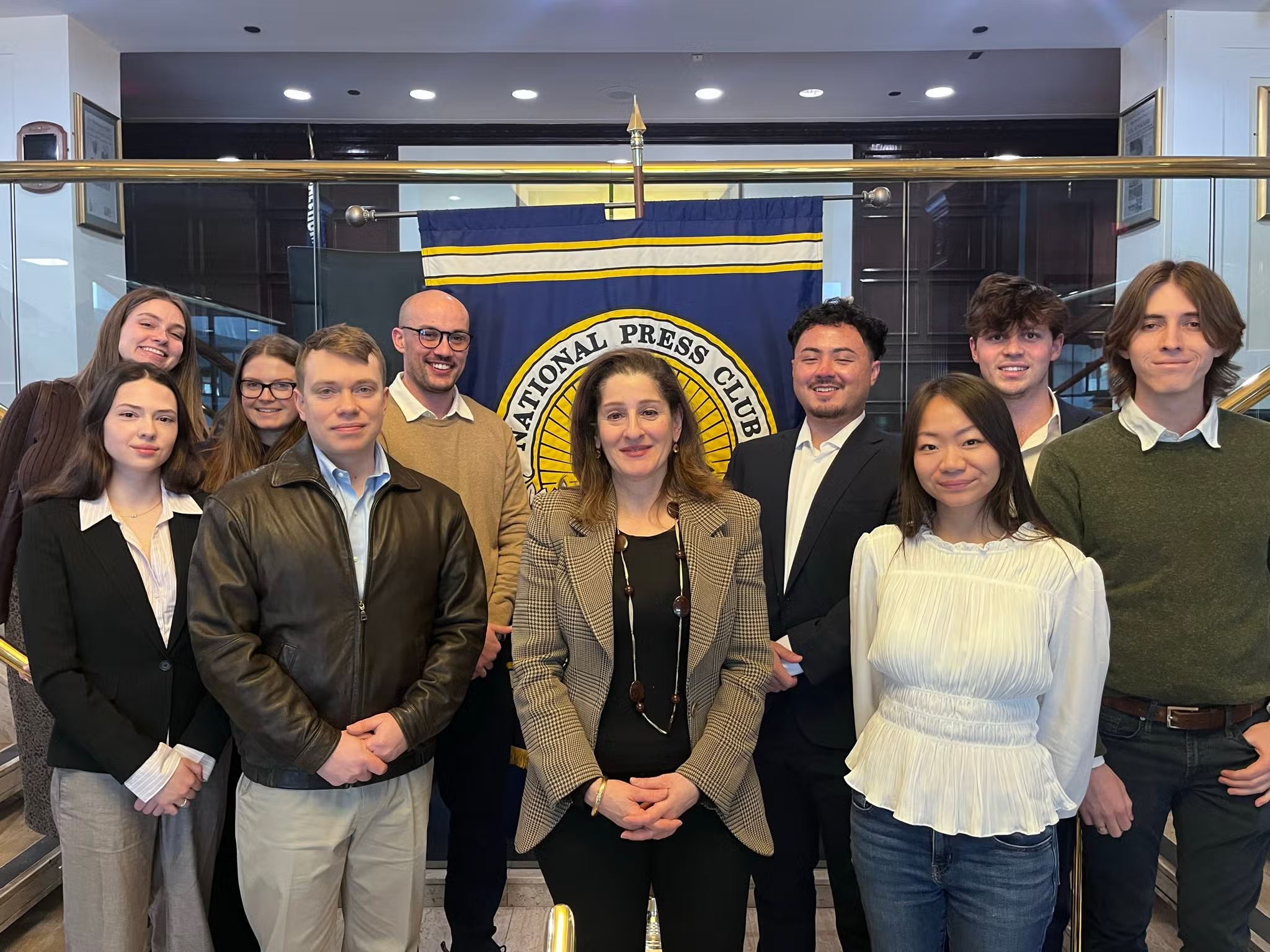
“CCAS will continue to project itself as both an institution and a method,” says Associate Professor Marwa Daoudy, the Seif Ghobash Chair in Arab Studies (a named chair she has held since the passing of its inaugural holder, CCAS founding scholar Michael Hudson) who also serves as director of academic programs at CCAS. “It is a site where intellectual work is shaped by commitments to language, history and lived experience, but also a model for how scholarship remains politically engaged.”
This intellectual tradition is rooted in the work of CCAS’s founding scholars such as Hisham Sharabi, Hanna Batatu and Michael Hudson, who helped shape the center as a place where scholarship could be both historically grounded and attuned to public debate. Their work reflected different intellectual styles—archival, theoretical, political and applied—but together, they helped build a center that has continued to ask how scholarship can respond to the realities of power, inequality and injustice.
“Our mandate is best understood as a living intellectual tradition,” says Daoudy, “a set of enduring commitments to critical inquiry, to solidarity with the people in the region, to production of knowledge that challenges dominant hierarchies and supports resistance against injustice and oppression.”
For Daoudy, this work is especially urgent now, as wars, displacement, climate injustice and the genocide in Gaza continue to shape life across the Arab world: “We strive to continue to offer alternative epistemologies and methodological tools that not only resist dominant narratives but also amplify the voices and histories of Arabs and other communities in the region, while honoring their deep-rooted connection to their land, their history.”.
Assistant Professor Killian Clarke situates the center’s future within broader pressures facing both the field of Arab studies and higher education in general.
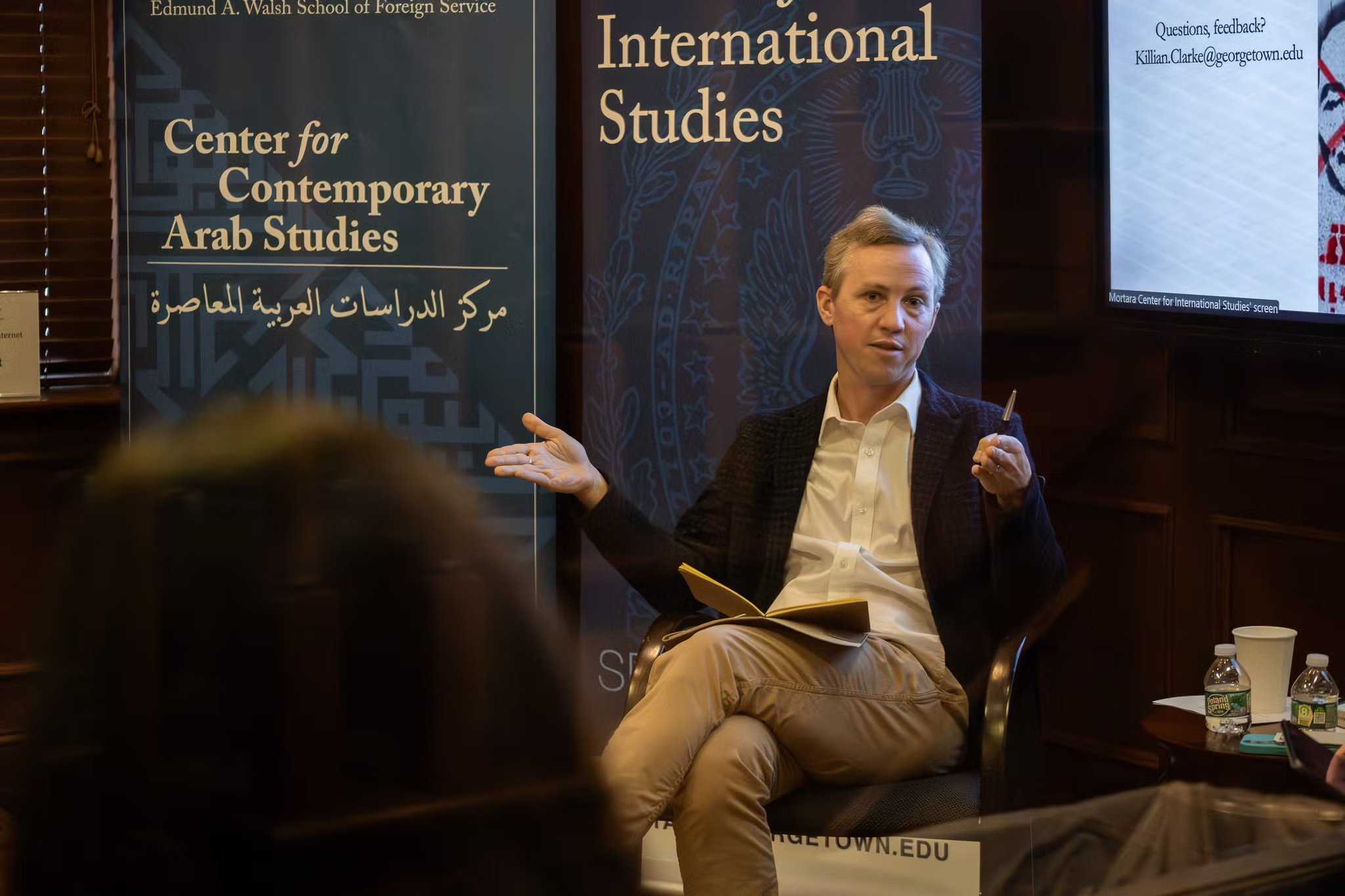
“Our 50-year anniversary offers a moment for celebration and also for reflection about the future of Arab studies,” Clarke says. “This is especially true because the timing of this anniversary coincides with a moment when Middle East studies—and area studies more broadly—is at a critical juncture.”
Clarke points to attacks on higher education, reduced federal support and broader questioning of the value of area studies and foreign language training: “At this moment, then, it is all the more important to embrace and re-invigorate our mission, so that we can offer another 50 years of engaged, rigorous and ethically-informed research and training on the Arab world.”
That work, Clarke says, includes supporting faculty research, continuing to strengthen the Master of Arts in Arab Studies program and preparing students to work in and on the region “in a rigorous and principled manner.” It also means preserving one of the center’s defining strengths—“maintaining world-class Arabic language training, so that our students can communicate seamlessly with those who live in the Arab world.”

Arabic has been central to CCAS since the MAAS program began. From the first graduating cohorts, students were expected to develop advanced Arabic proficiency, a requirement that set the program apart from many other Middle East studies programs in the United States. Associate Teaching Professor Belkacem Baccouche, who joined the faculty in 1977, has fundamentally shaped CCAS’ Arabic program across nearly five decades of teaching. He recalls that CCAS’ founders saw Arabic as integral to the master’s program, a view rooted in “their knowledge, their scholarship, travels in the area and their sense of justice.”
Baccouche sees that commitment to language study as part of the founders’ larger sense of purpose. “These men and women saw an urgent need to inform, to rectify what they believed was wrong in order to bring justice to those who had been wronged,” he says. “They had a vision and did their best to make it happen. I believe they made a difference.”
Alongside its emphasis on language, CCAS has also maintained a distinctive focus on the Arab world as a coherent field of study. For Adjunct Professor Noureddine Jebnoun, that focus remains one of the center’s defining contributions. He notes that CCAS is among the few academic institutions in the United States that studies the Arab world “as a single geographic unit,” rather than subsuming it under the broader and more ambiguous category of the “Middle East,” a term he describes as “a colonial, imperial artefact coined by outsiders to the region.” That distinction, Jebnoun argues, has shaped the center’s larger intellectual project. Over the past five decades, he says, “CCAS has been at the forefront of academic knowledge production, challenging colonial worldviews that shaped the contemporary Arab world.”
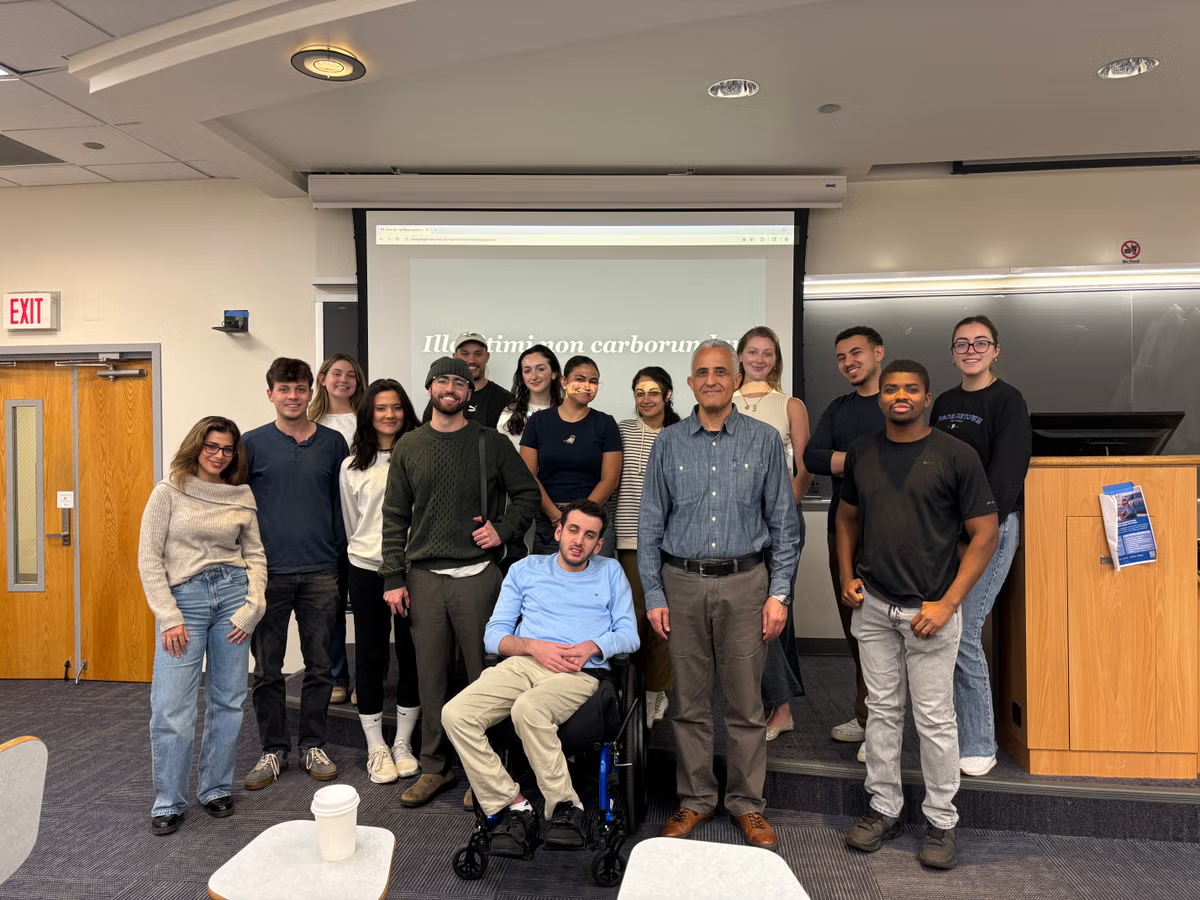
Looking ahead, he believes the center should continue to deepen that work. “CCAS must further invest in intellectual inquiry while enriching this with suppressed indigenous perspectives in order to empower future generations of graduate students in the realm of ideas,” Jebnoun says. “By doing this, students will be able to construct an alternative, decolonial framework to the hegemonic, theoretical lens structuring the Western field of area studies while advocating for Global South perspectives committed to collective agency, liberation and resistance.”
For Joan Mandell, an adjunct faculty member at CCAS who teaches classes on oral history and documentary filmmaking, the center’s future also depends on how well it responds to changes in the public sphere. She hopes to see CCAS expand its work in media and public-facing scholarship.
“I would like to see CCAS grow our initiatives to keep pace with the ever-changing media landscape, fostering direct conversations with popular narratives,” Mandell says. “That means more course offerings to expand our hub of knowledge production and funding for all sorts of media that bring our studies out into the world.”

Mandell also imagines MAAS students playing a larger role in shaping public conversations about the region: “I would also like to see the day when current MAAS students are prominently featured as pundits on inter/national news programs showcasing their thoughtful commentaries on the cultures and politics of the SWANA [Southwest Asia and North Africa] region that CCAS has so successfully and determinedly nourished.”
The faculty reflections point in different directions: language training, graduate education, research, media, public engagement and the continuing need to challenge dominant narratives about the Arab world. But they share a common thread. For CCAS, looking ahead does not mean moving away from its founding mission. It means carrying that mission into an ever-evolving political and academic landscape.
As Daoudy says, “By linking past intellectual traditions to present imperatives and future possibilities, Arab Studies will remain a vibrant space for imagining alternative futures.” For the next 50 years, CCAS faculty see that work continuing through scholarship, teaching, language study and the students and alumni who will carry the center’s mission forward.