
FIS, TÜRKIYE. A villager makes bread in an outdoor kiln in Fis, Türkiye, on February 24, 2012. Fis is known as one of the first meeting places of arrested Kurdistan Workers’ Party (PKK) guerrilla leader Abdullah Öcalan. Fis used to be home to 70 families, but the Turkish military destroyed much of the town repeatedly in 1993-1994 in retaliatory strikes for the villagers’ show of sympathy to the PKK guerrillas to whom they provided food and shelter (“They are our sons,” in the words of one villager). Only seven homes have been rebuilt in Fis after a period of forced exile from the village, and everyone is too scared to provide their name.
In an age of increasing global misinformation, media polarization and the rise of artificial intelligence, journalists are fundamental in documenting and understanding the global order.
Amanda Rivkin (SSP’11), a graduate of SFS’s Master of Arts in Security Studies program (SSP), has spent more than a decade working as a press photographer, news writer, editor and researcher for Deutsche Welle, The New York Times and myriad other publications. She has published widely in the U.S. and Europe, and her photographs have been exhibited in many cities around the world, from DC and Chicago to Milan and Aleppo. She has also served as a senior expert at the NATO Strategic Communications Centre of Excellence in Riga, Latvia.
Rivkin recently returned to the Hilltop to participate in the inaugural event co-hosted by SSP and the Bern Security Dialogue, a new independent geopolitical forum. As part of the new initiative, she authors the Alpine Security Monitor, a weekly newsletter that includes special reports on key issues influencing security in the broader Alpine region.
We sat down with Rivkin to reflect on what led her to SSP and connections between journalism and international relations. She also shared a compelling selection of images from her portfolio that illuminate this relationship.
Engaging with domestic and global issues
By the time she arrived at Georgetown in 2009, Rivkin had already been working as a journalist for several years. She had covered major national political stories, including Barack Obama’s victory celebration in Grant Park, Chicago, and the fall of then-Illinois Governor Rod Blagojevich a few months later.
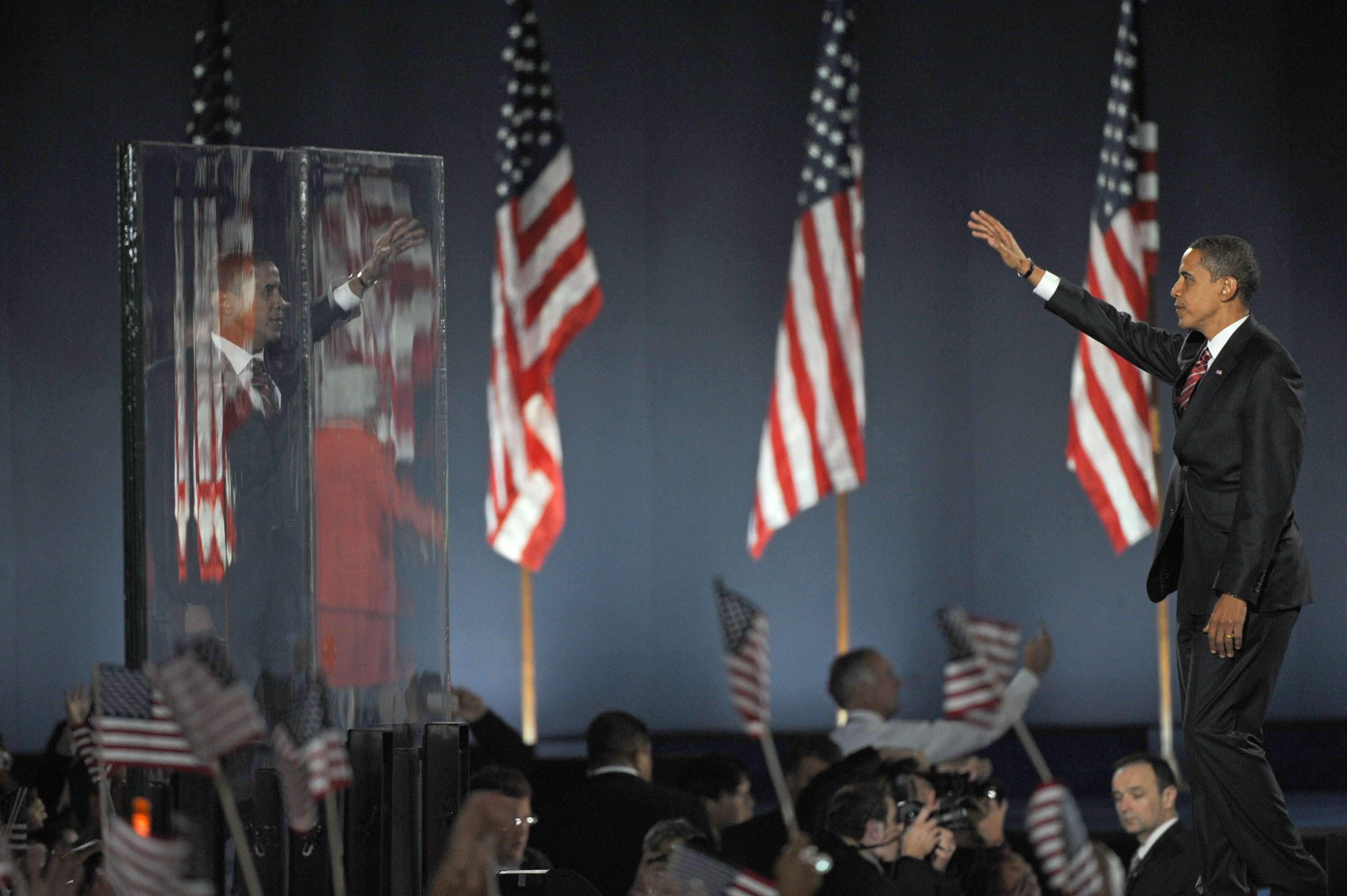
CHICAGO, ILLINOIS. Barack Obama waves to his supporters in Grant Park, Chicago, through bulletproof glass after winning the U.S. presidential election, defeating Republican John McCain to become the 44th U.S. president on November 4, 2008. Obama gave his victory speech to a crowd of just over 200,000 supporters.
At the same time, Rivkin was witnessing the peak years of the Global War on Terror—a term widely used from 2001 to 2009—but wanted a deeper perspective of these military and intelligence forces shaping events. “I was watching my country transform before my eyes, but I did not have any background in military or intelligence affairs really until that point to understand it,” she says. This ultimately led her to SFS and the Security Studies program.
“In a cratering media environment badly transitioning to an unknown digital future, a degree from Georgetown’s School of Foreign Service seemed like not only a window out to the rest of the world but a nice backdrop for whatever else I might wish to do later in life.”
At Georgetown, she was not only studying defense and security issues—she was shoulder-to-shoulder with individuals actively engaged in them: “Suddenly, I was in class with the people who were on the frontlines and professors who were shaping the American understanding of those front lines.”
Beyond a new academic focus, Georgetown also opened up professional opportunities. The summer after her first year in the program, Rivkin received a National Geographic Young Explorers Grant to travel the length of the Baku-Tbilisi-Ceyhan oil pipeline. After graduation, she received a Fulbright Grant in photography, which she used to return to Azerbaijan.
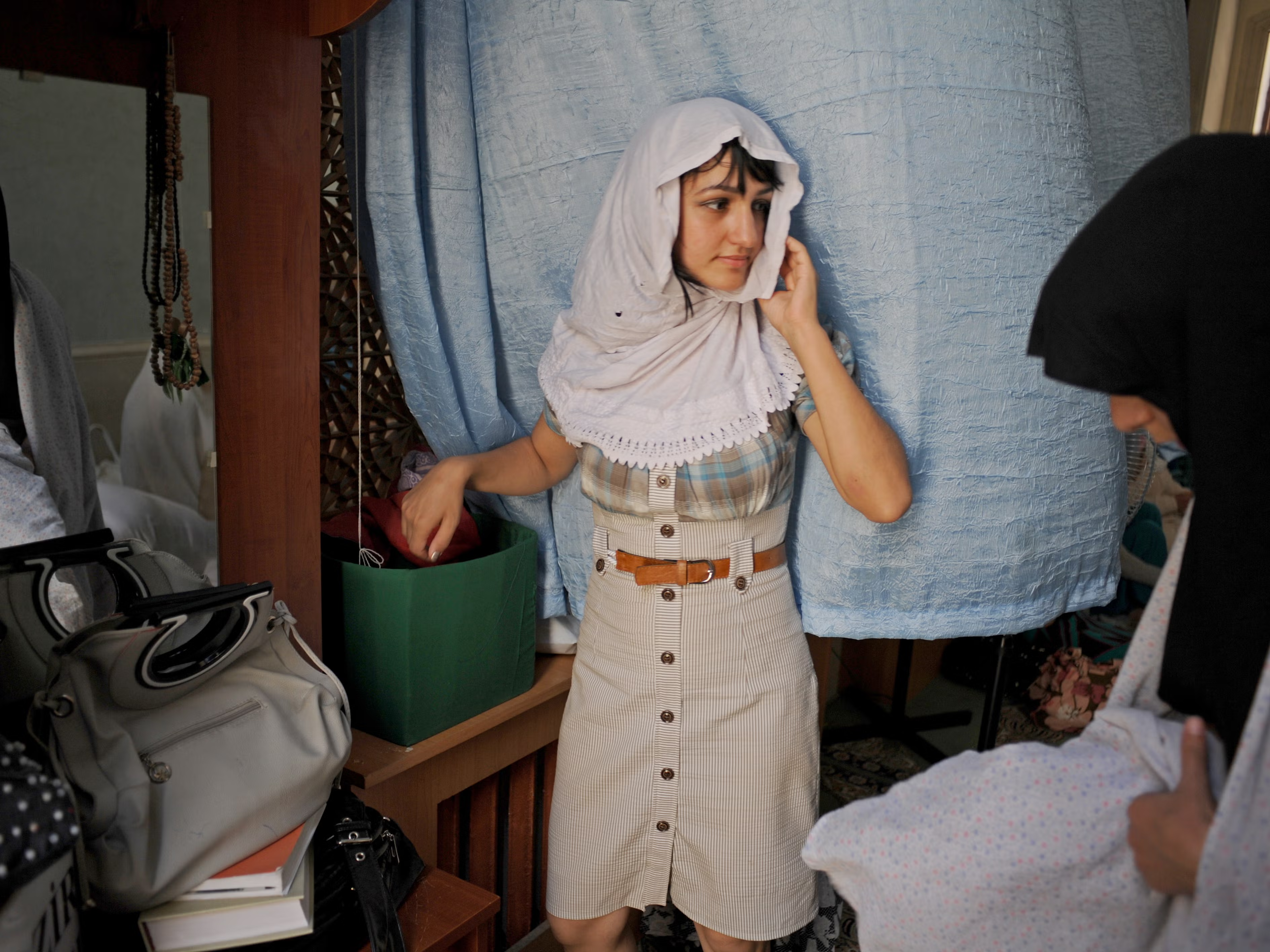
BAKU, AZERBAIJAN. Young girls dress themselves for prayer upon entering the Shi’a Icherisheher Djuma Masjid, or Inner City Mosque, for Friday prayers in the old city on July 2, 2010. Viewed as “the wrong message” by the ruling regime of Ilham Aliyev, Islam has been shunned in favor of opulence and materialism for the elite. The imam of the Icherisheher Djuma Masjid was replaced after dalliances with the opposition in 2005, the time of the last major civil disturbances, and Iranian-style clericalism.
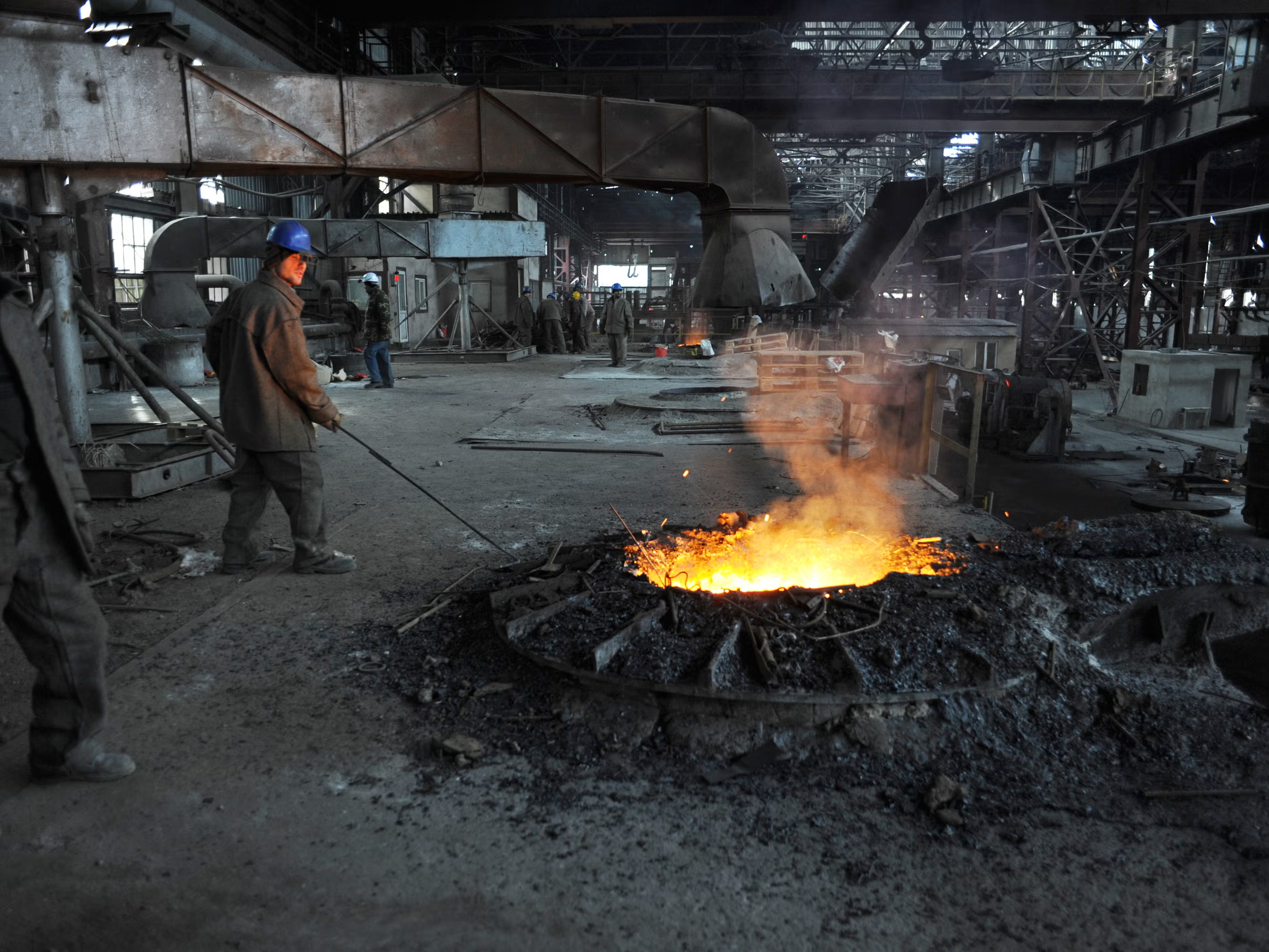
RUSTAVI, GEORGIA. Workers smelt scrap metal before it is converted to steel at the Rustavi Steel plant in Rustavi, Georgia, on January 20, 2012. Built in 1946 at the height of Stalinist power in the Soviet Union and upgraded in recent years, Rustavi Steel employs 1,750 in what was once the greatest industrial center of Soviet Georgia. Today, several heavy industry factories remain in the city, which is traversed by the Baku-Tbilisi-Ceyhan oil pipeline.
Security meets storytelling
Reflecting on how her studies informed her reporting, Rivkin explains that she learned to think critically about global issues not just as they unfold, but in terms of their long-term ramifications. While she describes the pace of the media industry as largely reactive and deadline-driven, she says SSP allowed her to cultivate an appreciation for the long view:
“My Georgetown education very much taught me and gave me this capability to think over the horizon.”
Over the course of her career, Rivkin has developed extensive experience in Central and Eastern Europe, Türkiye and the Caucasus, as well as the Midwestern United States. Her work has focused sharply on a range of political, social, humanitarian and security issues.
She has covered geopolitical developments around the world, including the Gezi Park uprising in Türkiye, new Ukrainian military recruits in Odesa in 2016 during the war in eastern Ukraine, ecological disaster in Hungary and postwar reconstruction in Bosnia.

ISTANBUL, TÜRKIYE. Women react to the tear gas in Taksim Square as riot police move on the square in Istanbul, Türkiye, on June 11, 2013. After 10 days of protest and occupying Gezi Park adjacent to Taksim Square, riot police moved to retake the square.

ODESA, UKRAINE. A Military Academy student marches down the street with a young woman beside him to a ceremony at the April 10 Monument where the student soldiers will be promoted to the rank of lieutenant in Odesa, Ukraine on February 26, 2016. With war raging in eastern Ukraine with Russian-backed separatists, more young men and women have enlisted, and the popularity of military education has increased, including among civilians.

AJKA, HUNGARY. The rupture in the toxic red alumina sludge reservoir is seen from the top of a remaining piece of the reservoir’s wall at the MAL plant in Ajka, Hungary, on November 22, 2010. On October 4, 2010, an industrial accident sent a torrent of toxic red alumina sludge pouring into the surrounding countryside and several villages, including Kolontár and Devecser, resulting in the deaths of 10 individuals, including a 14-month-old baby, injuring hundreds and leaving several families homeless.

SARAJEVO, BOSNIA AND HERZEGOVINA. Sephardic Jews pray in the Ashkenazi Synagogue on Shabbat in Sarajevo, Bosnia and Herzegovina, on October 17, 2014. Jewish community leader Jakob Finci (second from right) placed the number of Jewish people left in Sarajevo at 700. Part of the Shabbat service is in Ladino, an old dialect of Spanish that Jews who were expelled from Spain in 1492 took with them to their new homes across the Mediterranean world.
No matter how far she travels, Rivkin always brings those lessons back home. “What I saw in the field later helped me to interpret what I saw happening in my own country in a meaningful way,” Rivkin says.
At the same time, she underscores the continued need to look outward:
“It is no longer possible to look at the major events shaping our world on just a local or national level, especially given developments of the last two and a half decades.”
Looking outward, together
As both a producer and a consumer of news, Rivkin sees clearly how attacks on accurate information come from many directions, often leaving audiences overwhelmed. For students preparing to navigate this fast-moving environment—defined by distortion and digital noise—her advice is straightforward: broaden your perspective by stepping beyond your own vantage point.
“The only way to push back against all these very convenient and very cynical forces is to go out into the world, whether that is one’s community or a foreign country, and experience the world in a tactile and syncretic manner.”
As her experience and photographs illustrate, doing so in concert with others is critical. She emphasizes that one cannot develop analytical skills or understand the world based on any one person’s experience alone.
“Centuries of human experience are not on social media and the internet,” Rivkin says. “They are in libraries and in engaging with people who are older and younger, who are experiencing the same world we are but through a different prism, whether that is age, class, race, nationality, profession.”

BRATISLAVA, SLOVAKIA. Visitors are seen near the recently constructed monument to those who died trying to escape the communist regime by crossing into Austria by swimming a mere 40 meters across the Danube in Devín, Slovakia, on June 26, 2010. Located beside the Devín Castle, the once heavily fortified crossing point, among the narrowest in the former Eastern Bloc, was and remains a popular spot for local tourists and day trippers as the oldest castle ruins in Slovakia are perched on the adjacent hillside.
All photos and captions courtesy of Amanda Rivkin, used with permission.