This year, SFS’s Center for Contemporary Arab Studies (CCAS) celebrates its 50th anniversary. In this series, we’re commemorating the center’s impact and legacy by highlighting current students and alumni as well as past and present faculty. Their stories reflect CCAS’s dedication to understanding the complexities of the Arab world and engaging with the region in thoughtful and ethical ways.
Bassam Haddad (MAAS’94) describes the Master of Arts in Arab Studies (MAAS) program as a unique and generative institution. He also sees it as an incubator for many projects across his 34-year career, including the non-profit knowledge production organization, the Arab Studies Institute (ASI). He currently serves as director of the Arab Studies Institute and founding director of the Middle East and Islamic Studies program at George Mason University.
Haddad shared insights on leveraging CCAS’s intellectual community, key takeaways from his international career and advice for future Arab Studies students to make the most of their Georgetown experience.
CCAS as an intellectual hub
For Haddad, the journey to CCAS in the early 90s wasn’t just a career move—it was an entry into what he calls the “natural place to be” for Arab Studies. He especially recalls the unique concentration of scholars and researchers, noting the profound influence of faculty such as Hanna Batatu, Hisham Sharabi and Judith Tucker, among others.
ICC Auditorium Panel on 25th anniversary of the Arab Studies Journal, 2018 – Nadya Sbaiti (Editor), Bassam Haddad (Founding Editor), Judith Tucker, Sherene Seikaly (Editor), Amaney Jamal and Sinan Antoon (Editor).
While Haddad valued the classroom instruction he received, a pivotal moment in his MAAS education occurred just steps away from the Intercultural Center in Copley Hall. There, he attended an event featuring the prominent Palestinian-American academic and literary critic, Edward Said, whose work revolutionized Arab and Middle East Studies. To Haddad, hearing Said speak in person at Georgetown in the 1990s was akin to witnessing this academic revolution unfold.
“When you have so many wonderful things—a combination of people, atmosphere and a message, a purpose—in one place, that clustering can produce indelible marks on the intellectual life and memory and future of a context. This context is Washington, DC, the United States and Arab Studies, Middle East Studies,” Haddad says.
His experience at Georgetown fostered in him a strong commitment to bridging the divide between academic research and public engagement. This drive manifested early. In 1992, during his first year in the MAAS program, Haddad founded the Arab Studies Journal. Today, the publication continues to be housed at CCAS and published in collaboration with Tadween Publishing House, a sub-organization of the Arab Studies Institute.
Bridging academia and media in the Arab world
Building upon his graduate work, Haddad utilized his academic foundation to create accessible multimedia platforms designed to reach audiences far beyond the scope of academia. He recognized that while academic journals were vital, the public increasingly consumed knowledge through audiovisual means.
This realization prompted a shift from print to film. In 2003, alongside fellow Georgetown alumni including Sinan Antoon (MAAS’95), Maya Mikdashi (MAAS’04) and Adam Shapiro (MAAS’97), Haddad formed the first film team to enter Iraq after the American invasion. Together, they co-produced and directed the award-winning documentary, About Baghdad, the first of three films produced by ASI.
About Baghdad documentary co-directors in Baghdad, 2003 – Sinan Antoon, Bassam Haddad, Maya Mikdashi, Adam Shapiro and Suzy Salamy.
Haddad’s mission to democratize knowledge reached a new height in 2010 with the launch of Jadaliyya, a multilingual online magazine that combines local knowledge, scholarship and advocacy for audiences in the United States, the Middle East and beyond. Haddad explains how this publication bridged the gap between academic rigor and real-time reporting just as the Arab Spring began to unfold, becoming a go-to destination for researchers and scholars.
When you have so many wonderful things—a combination of people, atmosphere and a message, a purpose—in one place, that clustering can produce indelible marks on the intellectual life and memory and future of a context.
Bassam Hadddad (MAAS’94)
“We ended up producing, at the time, one of the most sought-after daily publications online that was viewed as produced by scholars but produced for a broader public,” Haddad says. “Several months after we started Jadaliyya, the Arab uprisings broke out, and we were able to harness the networks that we built since 1992 with the Arab Studies Journal to produce that locally-based knowledge, which came from these local areas like Cairo, Damascus and elsewhere.”
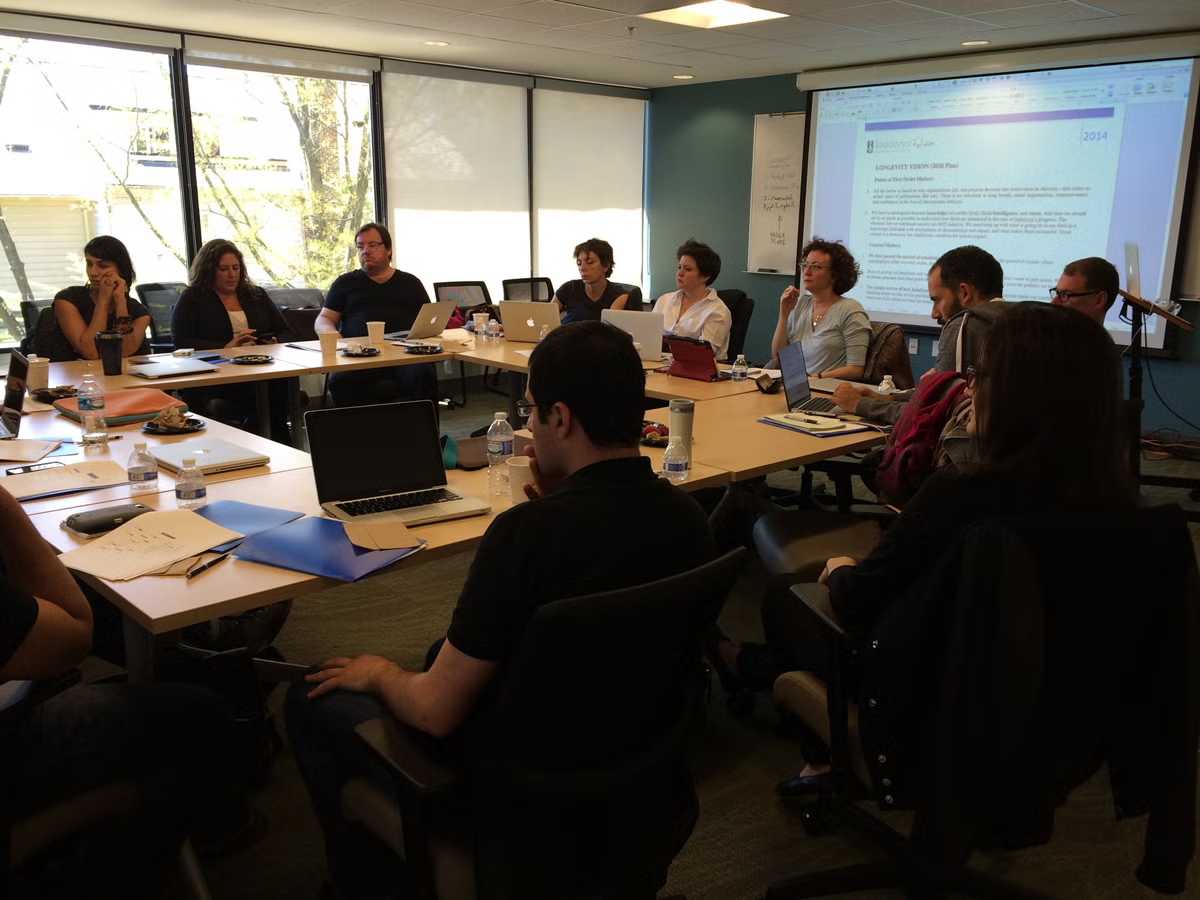
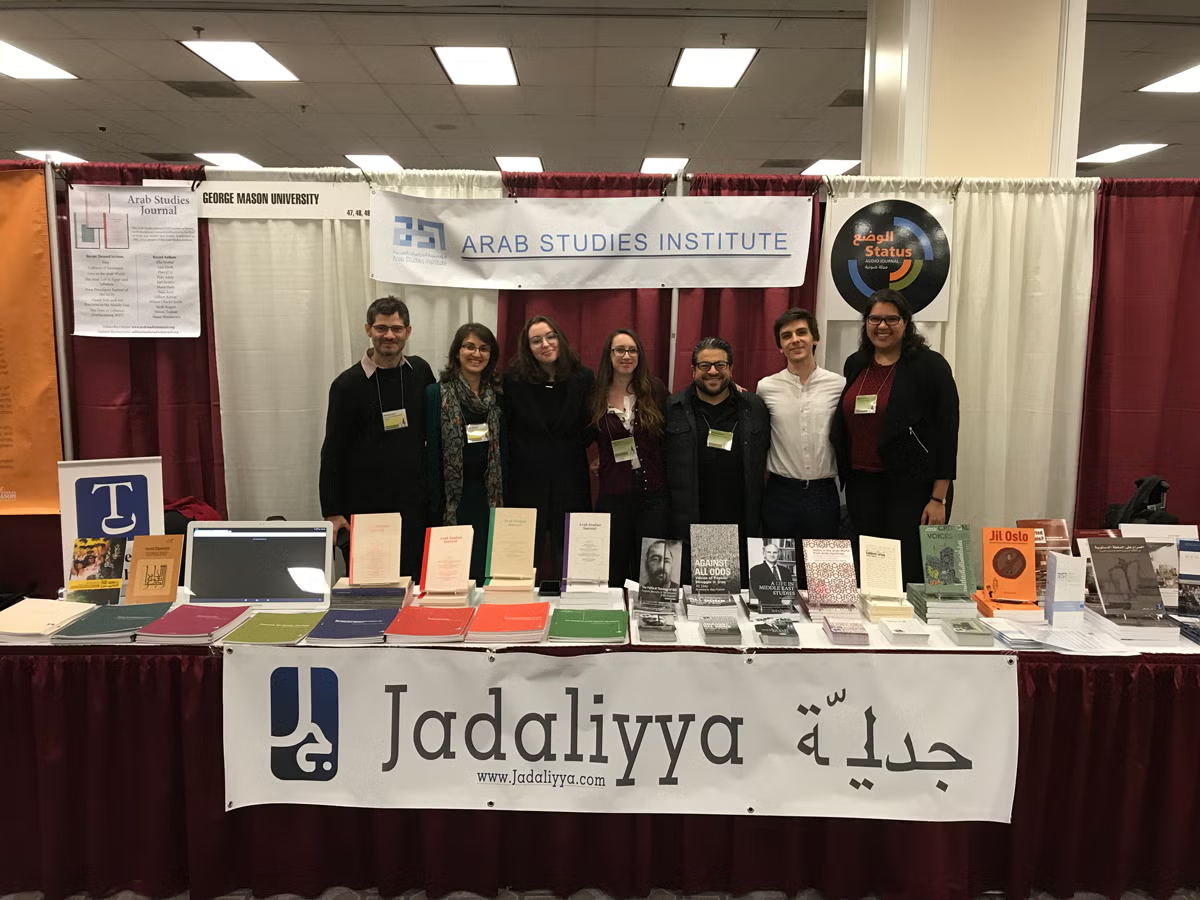
Jadaliyya’s first co-editors meeting, 2014, including a majority from MAAS, Georgetown.ASI/Jadaliyya booth at MESA (Middle East Studies Association) Conference, 2018.
Central to this multimedia work was an unwavering commitment to language. At CCAS, Arabic wasn’t just a graduation requirement; it was a lens through which to view the world. While Haddad brought a strong foundation in the language from his youth in Lebanon, his time at Georgetown taught him to view language as a tool for knowledge production—not only culturally important, but indicative of the way people think.
“And that is something that had to do with my Georgetown experience. Not because I wouldn’t have had the interest to do it in Arabic, or the knowledge, but being part of that atmosphere and recognizing the importance of indigenous languages to indigenous topics,” he says.
Enduring networks and advice for future students
Haddad’s advice to Arab Studies students is a call to presence: “Absorb every drop. Take in everything and bask in it. Do not waste that very precious period. That luxury is hardly and rarely appreciated intently and consistently. It is really a luxury to be able to be in college anywhere, let alone Georgetown.”
This attitude applies not only to the curricula but to the community itself. Haddad highlights the “unparalleled continuity” of the Georgetown network. He reflects on sitting in a seminar next to the future King of Spain, Felipe VI (MSFS’95), as an example of the eclectic synergy found on campus. However, he notes that his most meaningful and “organic” friendships were often with fellow scholarship students who shared his dedication to the field.
Haddad delivering a virtual presentation as part of a CCAS 50th Anniversary celebration during the fall 2025 semester.
Decades after his graduation, Haddad still collaborates with the same colleagues he met in the ICC. Whether returning to campus for the 20th anniversary of the Iraq invasion or continuing to manage the Arab Studies Journal from its original office, the network remains unbroken.
He urges students to embrace the rare privilege of being at the center of global knowledge production at such a precarious time in history. “Don’t hesitate to make connections with people,” Haddad says. “It’s very rare to be in a place where you could meet the world while being on 37th and O Streets in Washington, DC.”