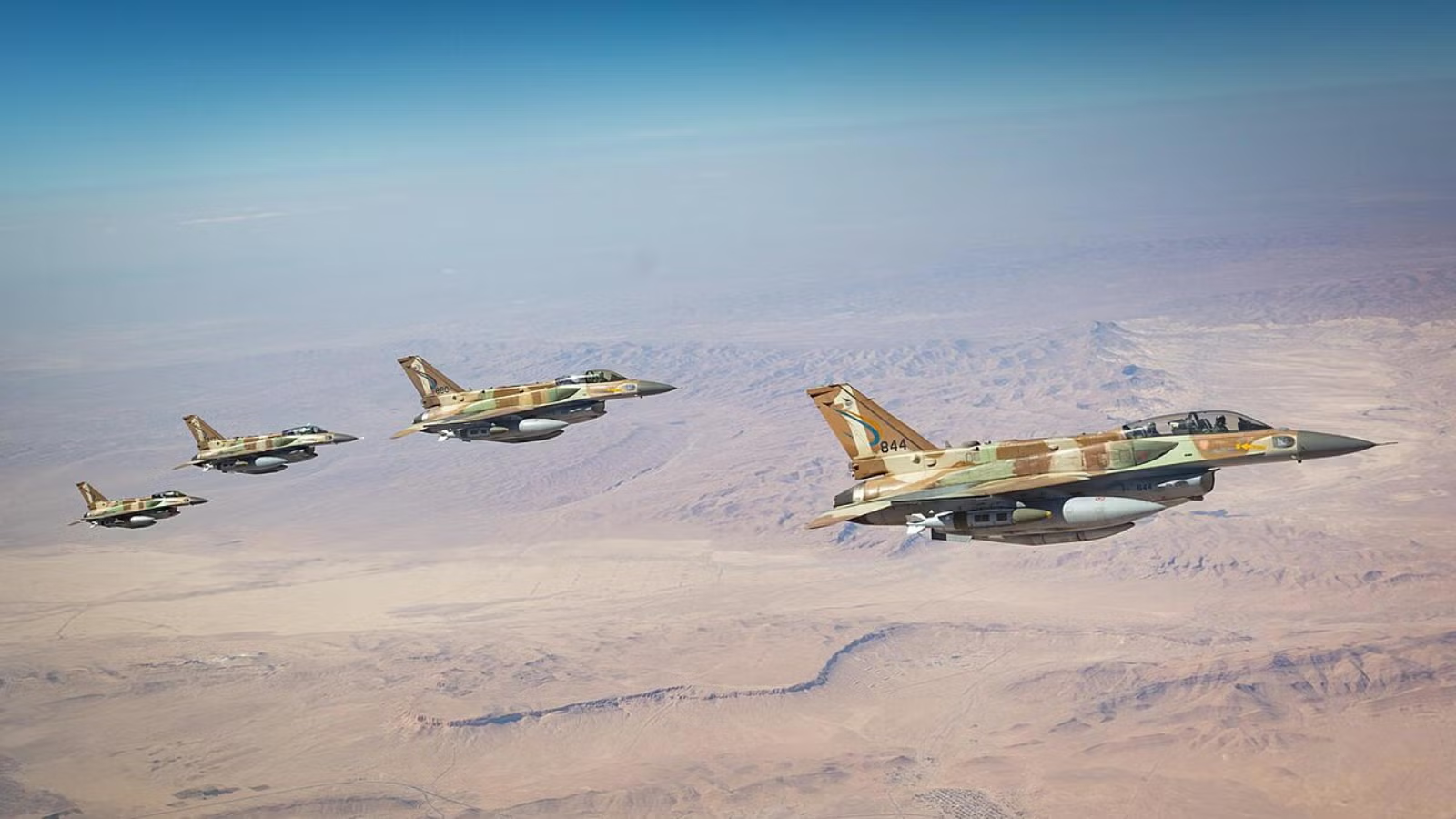
The U.S. and Israel attacked Iran on February 28. This followed weeks of threats from President Trump and the specter of a U.S. military buildup, as U.S. naval assets moved into the Persian Gulf, Gulf of Oman and Arabian Sea, and quickly resulted in the death of Iranian Supreme Leader Ali Khamenei. In the month that has followed, Khamenei’s son, Mojtaba, has been named Supreme Leader, but who is really leading Iran has been unclear.
As the situation evolves and the conflict continues, we asked several SFS experts, each of whom looks at the war in Iran through a slightly different lens, questions about what is going on and what the immediate future might hold.
Q. Given ongoing attacks by Israel in Lebanon, is it likely that this conflict will escalate into a broader regional war, or will the antagonists likely remain Israel, the U.S. and Iran?

Professor Daniel Byman: I do not think the ongoing war in Lebanon will lead to regional escalation, but it is already happening as part of the war with Iran. Tehran is trying to regionalize the conflict as a way to increase U.S. and allied pressure on the United States to halt operations—thus, Tehran has attacked infrastructure, U.S. bases and other targets in Turkey, Saudi Arabia, Qatar, the UAE and other countries. Some of these might join the United States and Israel in attacking Iran, although their role would be more symbolic given their limited military capabilities.
Q. The Trump administration has pushed to accelerate arms transfers to Gulf partners, particularly the UAE, Kuwait and Jordan. Will these sales enhance deterrence against Iran or risk deepening these countries’ entanglement in the conflict?
Byman: In the short term, greater U.S. arms sales to regional partners will not change the deterrence calculus with Iran. Tehran sees the conflict as existential, and marginal changes in partner military capacity will not affect this. That said, these countries are already entangled in the conflict, and I don’t think arms sales will increase that entanglement.
Q. How is Iran using its regional partners and proxies in response to U.S. and Israeli actions, and does the current conflict strengthen or strain those relationships over the long term?
Ambassador Barbara Bodine: Iran has no regional partners. Certainly not the Arab Gulf states and no longer Syria. Of its three main proxies, Hamas in Gaza is out of the game; Hezbollah in Lebanon continues to be pummeled; and the Houthis in Yemen have been eerily silent and can more easily survive without Iranian assistance. Iran is in this fight alone.
Byman: The current situation strains Iran’s relations with its proxies. Hamas is probably unable to respond to Iran’s situation given the devastation it has suffered in recent years. So far, at least, the Houthis are sitting this one out. Hezbollah has responded, but this response was weak due to the previous damage Israel inflicted on Hezbollah (primarily in 2024), and Israel has stepped up operations in Lebanon during the latest war with Iran, further weakening Hezbollah’s position there.
Q. How has the current war affected the Iranian government’s domestic legitimacy and Iranian public sentiment toward both the regime and the West?
Professor Nader Hashemi: It is hard to gauge this accurately for several reasons. There is an active war taking place; the Iranian regime has shut down the internet; and, more broadly, the Islamic Republic is a very oppressive regime that doesn’t allow for free and uncensored public opinion surveys, especially on this topic. What is clear in my reading of domestic Iranian politics is that the U.S. and Israeli attacks have generated a rising sense of patriotism and nationalism toward the country, not necessarily the regime itself. The rising civilian death toll and the attacks on cultural heritage sites have helped in this regard. What has also helped is the fact that both Trump and Netanyahu are very morally unscrupulous politicians.
Q. If any Iranian citizens were inclined to move against the current regime, have U.S. actions over the past four weeks helped them or harmed them? What are Iranians supposed to make of the current situation?
Hashemi: These U.S. and Israeli attacks have deeply undermined the internal struggle for democracy in Iran. The problem has deeper roots: Trump’s policy of “crippling sanctions” has produced mass poverty and pauperization for the average Iranian citizen. This war has made these underlying economic conditions significantly worse. It’s next to impossible for a starving and unarmed population to take on an entrenched authoritarian regime. In short, Iranians are stuck between a rock and a hard place. They are stuck between a deeply repressive regime on the one hand and an external military attack (by two odious leaders) on the other hand. The biggest victims of this war are the people of Iran.
Q. Reports from watchdog groups indicate that some U.S. military personnel have been told the conflict is part of a “divine plan” or linked to biblical end-times narratives. How is this perceived within Iran? Does it reinforce the Iranian government’s own framing of the conflict as ideological or civilizational rather than geopolitical?
Hashemi: It’s unclear to me how many people in Iran know about the phenomenon of Christian Zionism or the extremist religious politics of [U.S. Secretary of Defense] Pete Hegseth. The dominant internal regime framing of this war has not been via a “Clash of Civilizations” narrative. The dominant framing has been via the politics of Third World anti-colonialism and anti-imperialism. Iran’s modern history has been deeply shaped by the intervention of outside European powers: first, the Russians and British, and post-WWII, the United States. The Islamic Republic is telling its citizens that this is simply another chapter in a longer story of Iranian subjugation and humiliation at the hands of the West. In this sense, they can appeal to secular segments of society as well as religious supporters.
Q. Looking beyond Iran to its neighbors: Iraq has already been drawn into the conflict, with strikes in Baghdad and the Kurdistan region. How does Iraq’s role today compare to its position in earlier regional wars? Is any conflict that engages both Iran and Iraq likely to open wounds from their own eight-year war in the 1980s, or has too much changed in the region for that older conflict to be relevant?
Professor Joseph Sassoon: The Iran-Iraq War of 1980-88 is what “made” Iran. The brutal eight-year war started barely a year after the Islamic Revolution that toppled the monarchy. One cannot understand Iran today without understanding the historical implications of this war. The fundamentals of the Islamic Revolutionary Guards Corps (IRGC) cannot be fathomed without analyzing how the eight-year war shaped this militia.
Iraq of 2026 is very different from the old Iraq. Iran’s influence, directly and indirectly, is huge in today’s Iraq. This is true, both within the government and given the important role of militias sponsored and supported by Iran. It is doubtful that a new conflict between the two countries will flare up. However, if Iran is very weakened, its supporters in Iraq would be impacted. If there is a change in regime, it will definitely influence Iraq, depending, obviously, on the nature of the new regime.
Q. Previous U.S. intervention in the region has had impacts of which most Americans may be less aware. To what extent are today’s Iranian-backed militias in Iraq a legacy of the U.S. invasion and occupation after 2003?
Sassoon: There are two major winners of the U.S.-led invasion of Iraq in 2003. Economically, it is China. Politically and without any doubt, it is Iran. The U.S. got rid of Iran’s biggest enemy, i.e., Saddam Hussein. Hence, Iran gained political and economic influence in Iraq. Today’s militias in Iraq were a direct result of the invasion. Iran’s support has been consistent and significant since 2003.
Q. What lessons from Iraq’s recent history, especially since the U.S.-led invasion of 2003, might help us understand the risks of regional spillover in the current war in Iran?
Sassoon: The 2003 invasion had many unintended consequences. When Iraq was invaded, there were hopes of a democratic wave to sweep the region and, in particular, two regimes: Iran and Syria. Not only did that not happen, but Iran, without its nemesis Saddam, became the dominant regional power. Syria’s authoritarian regime was bolstered, knowing that the U.S. would not invade another country after the fiasco in Iraq. Overall, one could argue that authoritarianism in the regime strengthened; many countries benefited directly or indirectly from the chaos that prevailed in Iraq, particularly during the civil war of 2006-2008.
Q. How effective are efforts by countries like Oman, Qatar and Saudi Arabia to mediate between Iran and the United States?
Bodine: As of this writing, Trump says there are ongoing talks with the Iranians, although it is hard to figure out who that might be, or even if there are credible talks, as opposed to Trump looking for an escape hatch. The Iranians have denied such talks—which may be a question of semantics. There are no direct talks, but mediators are, well, mediating between the two sides.
According to reports, the mediators are Egypt, Saudi Arabia and Turkey, with Witcoff and Kushner for the American side. Trump has tabled one of his signature multi-point plans, which read more like ultimatums and may be as successful as similar multi-point plans tabled or as Ukraine-Russia and Gaza-Israel. There remains the question of who can effectively negotiate for the Iranian side. As the president has pointed out, most of those on our list are now dead, killed by the Israelis.
Trump has said he will end the war when his gut tells him it is the right time. He forgets this is not something he alone can decide. But whether the mediators can be effective does depend on how badly the President wants this to end and if he can spin whatever is agreed to into a “win” for him.
Hashemi: The two countries that have played a key role as mediators are Oman and Qatar. Both Doha and Muscat tried to prevent this war. To date, their mediation has been ineffective, because Trump views them as expendable allies who will not seriously challenge U.S. policy toward the region. I do believe both countries were sincerely interested in mediation and conflict resolution prior to February 28. The one key regional ally who has played a critical role in this war and who clearly has the ear of the American president is the prime minister of Israel.
Q. How is the war reshaping diplomatic relations between the United States and its Middle Eastern partners and among regional states themselves?
Bodine: In the short term, Arab Gulf anger is directed at Iran, and their efforts are at stopping the war. The long term relationships will depend in part on the terms of the war’s ending and what comes next for Iran. For decades, the Arab Gulf states have seen their partnership with the U.S. as a security shield. Our long-standing military cooperation has provided the means to counter much of the Iranian attacks. However, their relationship with the U.S. is now clearly also a bull’s-eye. And they will not soon forget that the U.S. provided no warning at the start of the war. None. There is a perception that Trump’s transactional approach to their relations is one-sided and one-way. Business may continue or resume. Trust will be far more difficult to rebuild—more so if they see their interests thrown under the bus as part of any peace deal, and if they are left to deal with whatever emerges in Iran.
Q. Earlier in March, President Trump temporarily eased sanctions on countries buying Russian oil in an attempt to blunt the impact of the Strait of Hormuz being compromised by Iran. Is this a wise move, either strategically or diplomatically?
Bodine: No. Nor is it wise economically.
Professor Charles Kupchan: No, it is not a wise move. The decision has had little impact on global energy prices, which are for now being pushed up by the closure of the Strait of Hormuz and damage to production facilities in the Gulf region. Furthermore, the decision is increasing Russia’s energy revenue, thereby bolstering Moscow’s ability to continue its war against Ukraine. Russia had been facing a consequential decline in energy revenue, leading to higher taxes and deficits. Now, such constraints are easing. Ukraine was already disadvantaged by the flow of attention and weapons to the Middle East. Now, it also faces an enriched aggressor.

Q. NATO leadership has explicitly ruled out direct involvement in the U.S.-Iran conflict. How is U.S. public pressure—and direct, personal pressure from President Trump—received in different NATO members’ domestic political environments?
Kupchan: Trump does not enjoy much popular support in most European countries, and haranguing Europeans over Greenland, Iran and other issues only makes matters worse. However, most European governments are bending over backwards to work with Trump and prevent an irreparable rift in the transatlantic relationship. So far, that strategy is working. The guiding rule of thumb is “work with Trump when we can, stand up to Trump when we must.”
Q. How is this war affecting the existing internal divisions within the alliance, and do those divisions risk undermining NATO’s broader credibility?
Kupchan: Trump’s policies toward Ukraine and Greenland and his dismissive attitude toward allies has taken a toll on NATO’s solidarity. The Iran War adds to the strains, but there is also a level of support in Europe stemming from awareness of the trouble that Iran has long been causing in the Middle East. If the question is whether the war in Iran will “break” NATO, the answer is likely no. Europeans are playing the long game and trying to ride out this war—and the Trump era along with it.
Q. Why are many NATO allies reluctant to take on a maritime security role in the Strait of Hormuz, even given the global economic stakes?
Kupchan: NATO allies may end up playing a role in helping with maritime security in the Strait of Hormuz, but only after a cessation of hostilities. An escort mission in the Strait in the midst of this conflict would be very complicated and dangerous. Given that the Strait is narrow and shallow, Iran has multiple ways to disrupt traffic, including mines, autonomous naval vessels, speedboats and missiles. Not even the U.S. Navy is prepared to take on this mission—at least for now. Iran is well aware of its ability to hold the Strait hostage, which is strengthening its bargaining leverage and its readiness to keep fighting.
Q. Given that both Japan and South Korea rely heavily on Middle Eastern energy imports, how vulnerable are their economies to disruptions caused by the conflict, particularly as shipping through the Strait of Hormuz is threatened?

Professor Victor Cha: Japan and Korea are upwards of 90 percent and 65 percent, respectively, dependent on shipments through the Strait of Hormuz; thus, the current disruptions are affecting them acutely. Both countries would like to see the conflict abate and have been asked by the president to contribute to ensuring safe passage. The Japanese prime minister was just in DC last week for her summit with President Trump, but the conversations on this issue were kept low-key, while the focus was on new investments by Japan to the U.S. pursuant to the trade and investment agreement concluded in 2025.
Q. How are Japan and South Korea balancing their focus on regional security concerns, such as North Korea and China, with growing pressure to respond to instability in the Middle East?
Cha: For both Japan and Korea, it is hard to disentangle conflicts in the Middle East or Europe from their theater. Increasing cooperation among Iran, Russia, China and North Korea have created a “one theater” security concept for Tokyo and Seoul. As a specific example, drone factories in Russia are now pumping out Iranian-designed drones with North Korean factory workers on site and Chinese machinery and other economic support.
Q. How should we understand President Donald Trump’s request that Japan contribute more directly to securing shipping lanes or supporting U.S. operations related to Iran? How do these requests conflict with Japan’s post-World War II constitution and its conduct in international affairs over the past 80 years?
Cha: For both Japan and Korea, their domestic legislation does not permit aiding parties to an active conflict. So, the answer to the request is punted now until hostilities cease. Both allies have supported the U.S. in conflicts before—Korea had a division in Iraq, and Japan did fueling reoperations in the Indian Ocean in support of OEF [Operation Enduring Freedom] in Afghanistan. But the circumstances are different in the Iran war. Neither was consulted about the war. To complicate matters further, each will likely be in conversations with Iran about being exempt from the shutdown of the Strait, which is unlikely to go over well with Trump.