

Over her time at SFS, Sharon Huang (SFS’26) says she’s learned to “slow down and ask yourself what you actually value and why you are doing what you’re doing,” a principle that eventually guided her to the Dikran Izmirlian Program in Business & Global Affairs (BGA).
Throughout her college career, Huang has centered her studies on global affairs and refugee studies, a focus that allowed her to integrate her cross-cultural background with new perspectives and experiences gained in the program. She emphasizes the value of fostering community, pursuing intellectual curiosity and charting an individual path.
“BGA was the only program found that refused to treat business and the world as separate things—and it turned out to be exactly the right fit for someone who has always lived at the intersection of different cultures, systems and perspectives,” Huang says.
Building a multicultural perspective
Born in Nanjing, China, Huang moved to Sammamish, Washington, in middle school. She describes her life as shaped by transitions across cultures, languages and places—and says she quickly found a sense of belonging in SFS’s global community.
“Those crossings made the School of Foreign Service a perfect space for me to continue having cross-cultural conversations with friends and classmates from different backgrounds,” Huang says.

Development).
Expanding her global perspective outside of the classroom, Huang had two immersive experiential learning trips during her time in the BGA program. The first took her to the Dominican Republic, where she engaged with development and cross-cultural questions firsthand through meetings with local stakeholders, gaining different perspectives on balancing sustainability and community rights.
Huang also participated in a BMW Supply Chain trip that spanned Germany, Mexico and South Carolina, an experience that offered her “a rare opportunity to trace a single global supply chain across three continents and observe how geopolitics, labor and logistics intersect in real time,” she says.
Finding an academic purpose
Huang admits she was skeptical about studying economics and business when she first came to the Hilltop. This perspective shifted after she took an introductory BGA course, motivated by a simple desire “to understand how policy, politics, social issues and business are actually interconnected,” she says. This experience completely changed her mind, leading Huang to commit to the program, which she complemented with a minor in statistics.
“I stayed for the rigor and complexity of the courses, for the global challenges we were asked to think through seriously and for the unique experiential opportunities the program offered,” she says.
However, one of the most memorable and influential courses Huang took was outside of her major: Zombie Law & Literature in the English department. She described the unconventional class, taught by Professor Kathryn Temple, as being impactful precisely because of its unique approach. According to Huang, “The course used novels, films, podcasts and legal texts together to reveal how law functions not just as a set of rules, but as a living cultural institution that can either protect human dignity or hollow itself out into ritual.”
Huang also emphasizes how the course helped reorient her interest in immigration law: “It gave me language for something I had sensed but couldn’t articulate: that the law is only as just as the people who insist on keeping it alive.”
Huang dove deeper into immigration policy through her work in the Laidlaw Research Fellows program. Working with Professor Christi Smith at Georgetown’s Institute for the Study of International Migration, Huang conducted original research on how consulting firms shape policymaking around migration and refugee integration.
On Smith’s impact, Huang was grateful not only for her support on the project, but for finding her larger academic purpose.
“She was more than a research mentor—her encouragement and unwavering faith in me were the primary reasons I dug deep into refugee studies at a time when the world seems to be giving them up,” Huang says.
An extracurricular focus on facilitating engagement
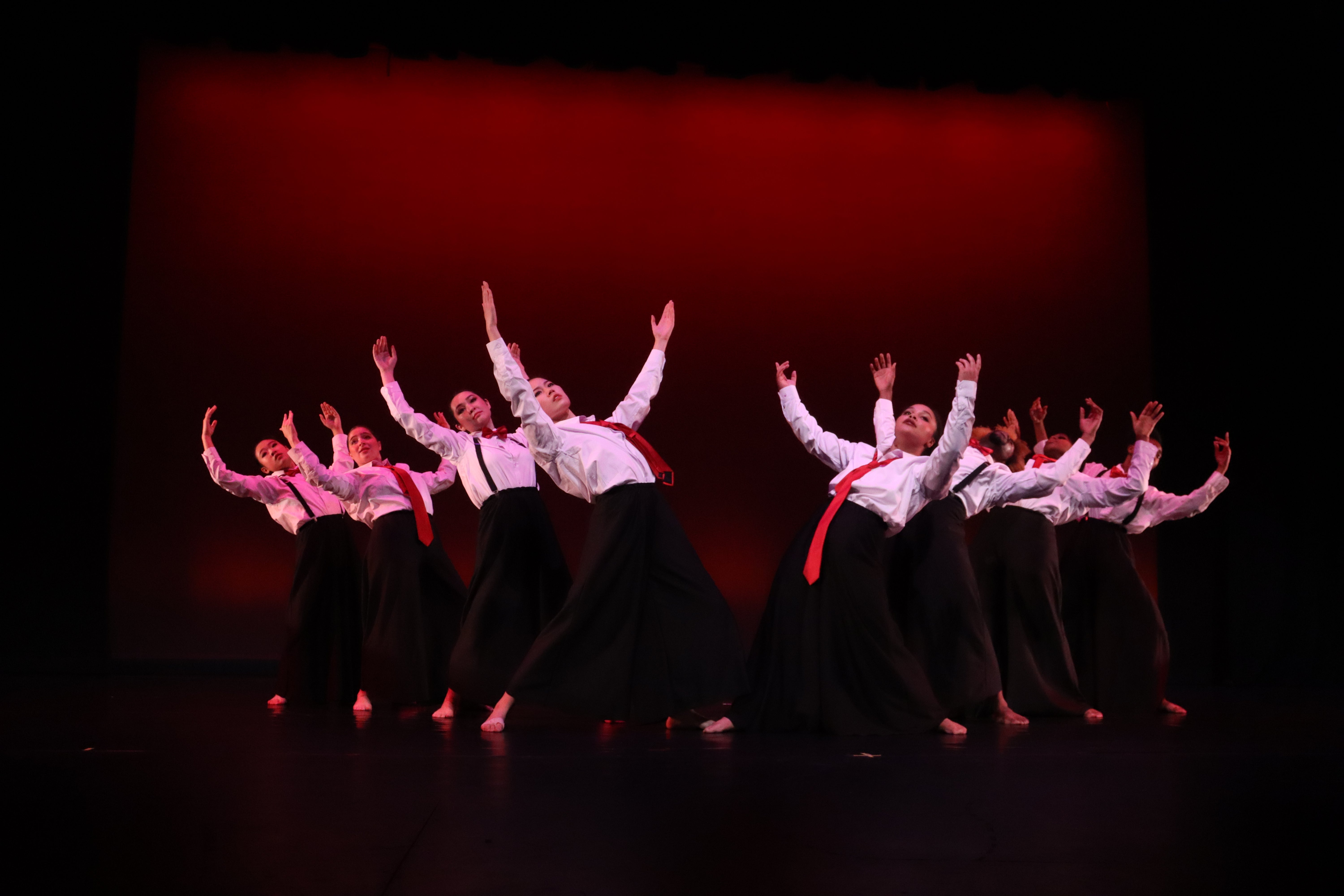
Beyond her academics, Huang was deeply involved in policy, journalism and civic engagement. On campus, she was also a member of Black Movements Dance Theatre, Asian Baptist Student Koinonia and The Georgetown Review.
As the director of events and finance for BridgeUSA DC, a chapter of the multi-partisan student movement BridgeUSA, Huang helped foster a solution-oriented political culture and promote viewpoint diversity and responsible discourse. The afternoons and evenings spent with this community—hosting speakers, running seminars and facilitating discussions—led to some of her most memorable moments at Georgetown.

“At a time when political polarization and apathy felt overwhelming, those rooms were proof that honest, constructive dialogue is still possible,” Huang says.
Beyond the Hilltop, Huang served as a workforce development research intern at the American Enterprise Institute, a prominent think tank, conducting research, creating graphic visuals and co-drafting an op-ed on reentry policy. She also served as vice president of development at the Open Foreign Policy Initiative, a political project led by students and young professionals committed to redefining America’s global participation, for which she led grant-writing, fundraising and social media outreach. Most recently, Huang has worked in freelance consulting for asylum seeker nonprofits.
Lessons for the future
As she prepares to graduate, Huang reflects on the ways that the SFS community challenged her to connect her knowledge to causes that matter to her and gave her “the freedom to go deep for the sake of it.”
“Georgetown gave me the rare permission to go as far down a rabbit hole as I wanted—a niche historical event, a contested philosophical question, an idea that had no immediate practical application—and to find that worthwhile in itself,” she says.

Huang continues: “That kind of learning accumulated into something I can’t put on a resume: a genuine zeal for knowledge, a deep-rooted curiosity about this world and the habit of recognizing how little I actually understand.”
This August, Huang will begin a full-time position at Guidehouse, where she had previously interned, as a consultant on the transportation team: “I am especially excited to apply the knowledge I gained through the BGA program—in international trade, global economic order and tariff policy—to engagements with entities like USPS and other federal transportation clients navigating an increasingly complex geopolitical and regulatory environment.”
In the longer term, Huang hopes to one day pursue law school with a focus on immigration law and continue her work consulting for asylum seeker nonprofits.
“The SFS gave me both the analytical toolkit and the moral clarity to pursue work at this intersection—training me to see problems systemically while keeping the human stakes in view,” Huang explains.
Reflecting on the advice she would give to her younger self, Huang says that “for those who take the time to slow down, identify what they genuinely care about and pursue it with determination and perseverance, Georgetown is a hidden gem that has something to offer at every turn. The right professor, the right campus group or institute, the right group of peers—they are all here.”