
Developing empathy and cultural awareness through experiences outside the classroom is an important part of an SFS student’s education. To this end, SFS offers a variety of opportunities designed to place students in the field. These programs offer rigorous hands-on training in local communities and allow students to learn directly from practitioners.
This spring break, SFS students embarked on Centennial Labs and other travel programs to bring their international affairs education to life. From practicing forensic methodologies in Romania to unpacking political economies in Ghana, students gained a front-row seat to the complexities of development, history and cultural studies.
Africa is People (Ghana)
Faculty: Kwame Otu
In this Centennial Lab led by SFS Professor Kwame Otu, students came face-to-face with the violent legacies of slavery and colonization and how Ghanaians navigate the afterlives of these histories unevenly. Students also engaged with Ghanaian intellectuals at the University of Ghana who specialize in the complex and messy histories and cultures of Ghana to understand what futures Ghanaians are making for themselves in the face of adversity and uncertainty. Using Ghana as a case study, this trip prompted a re-examination of the politics surrounding rescue efforts and economic development.
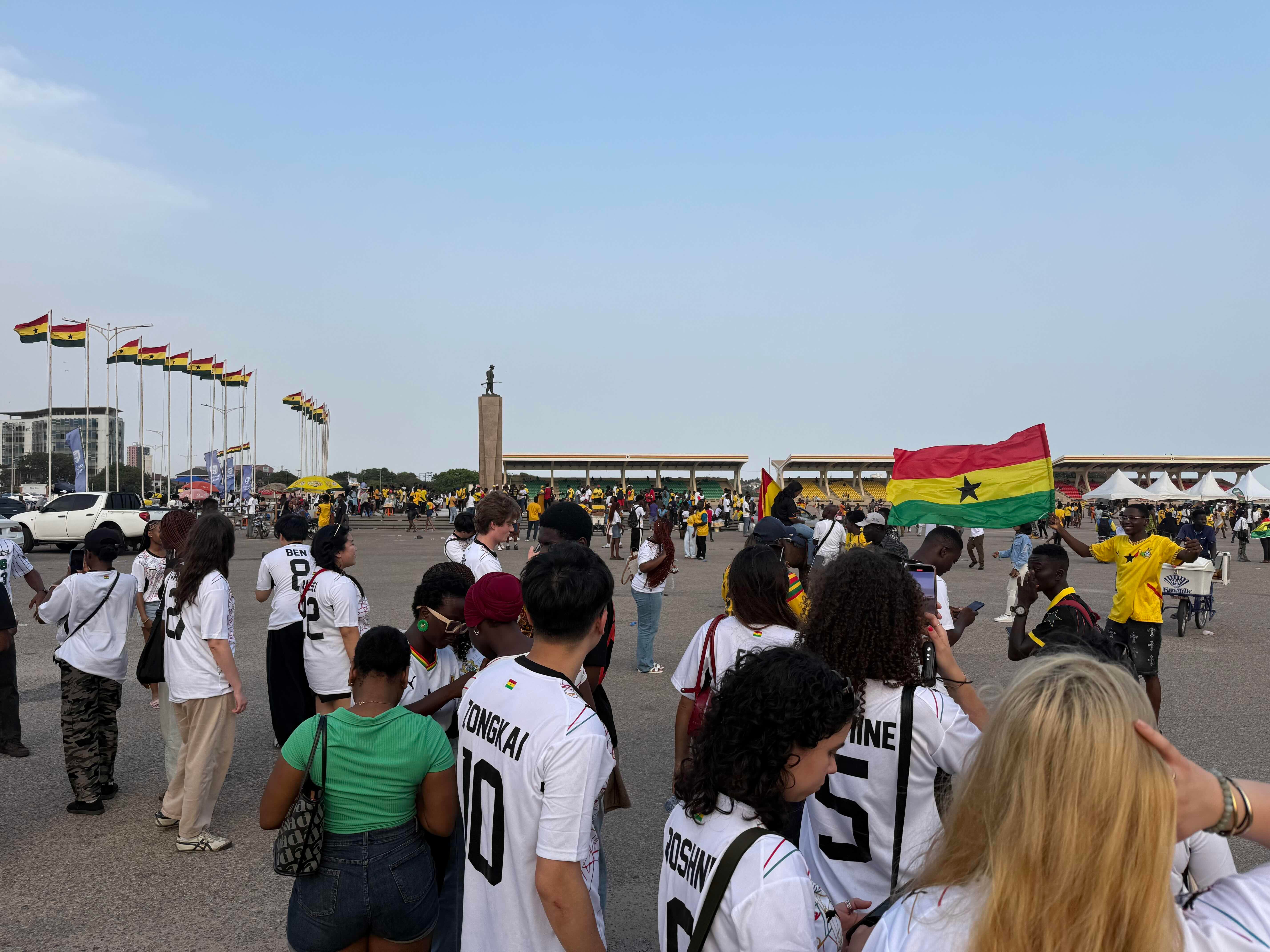

To add flesh to these intellectual discussions, students interacted with iconic sites such as Black Star Square, the W. E. B. Du Bois Center, the Kwame Nkrumah Mausoleum, Nkyinkyim Contemporary Museum, Shai Hills Reserve, Elmina Castle and NGOs like Priorities on Sexual Rights and Health (PORSH). These visits offered glimpses into the infrastructures of slavery and colonization, as well as the postcolonial monuments that an emerging Ghana built in order to transition from that past. This was complemented by learning directly from and engaging with Ghanaian students to foster a deeper, critical understanding not only of Ghana, but the African continent. An important highlight of this trip was meeting Ghana’s first female vice president, Professor Naana Jane Opoku-Agyemang, a specialist on slavery and colonization. She welcomed students to her official residence to discuss the impacts of slavery and colonization on Africans.
Alternative Spring Break in Nairobi, Kenya
Faculty: Lahra Smith, John Kraemer
The Alternative Spring Break in Nairobi, Kenya, led by the African Studies Program and facilitated by SFS Professor Lahra Smith and Professor John Kraemer from the School of Health, is designed to confront classroom theory with real-world complexity. In Kenya, students examined one of Africa’s most dynamic political economies—a landscape that faces complex challenges even as it leads global innovations in health, mobile technology and decentralization.
For Noon Elmostafa (MIMR’26), a graduate student in the Master of Arts in International Migration and Refugees program, the connection was instantaneous—and quite literal.
“In those few first moments in Nairobi airport, I witnessed how the politics and economics of the country were deeply intertwined,” Elmostafa observes. “There it was in the corner of my phone, Safaricom, just as it was on everyone else’s phone around me, all of us suddenly connected to the same network.”
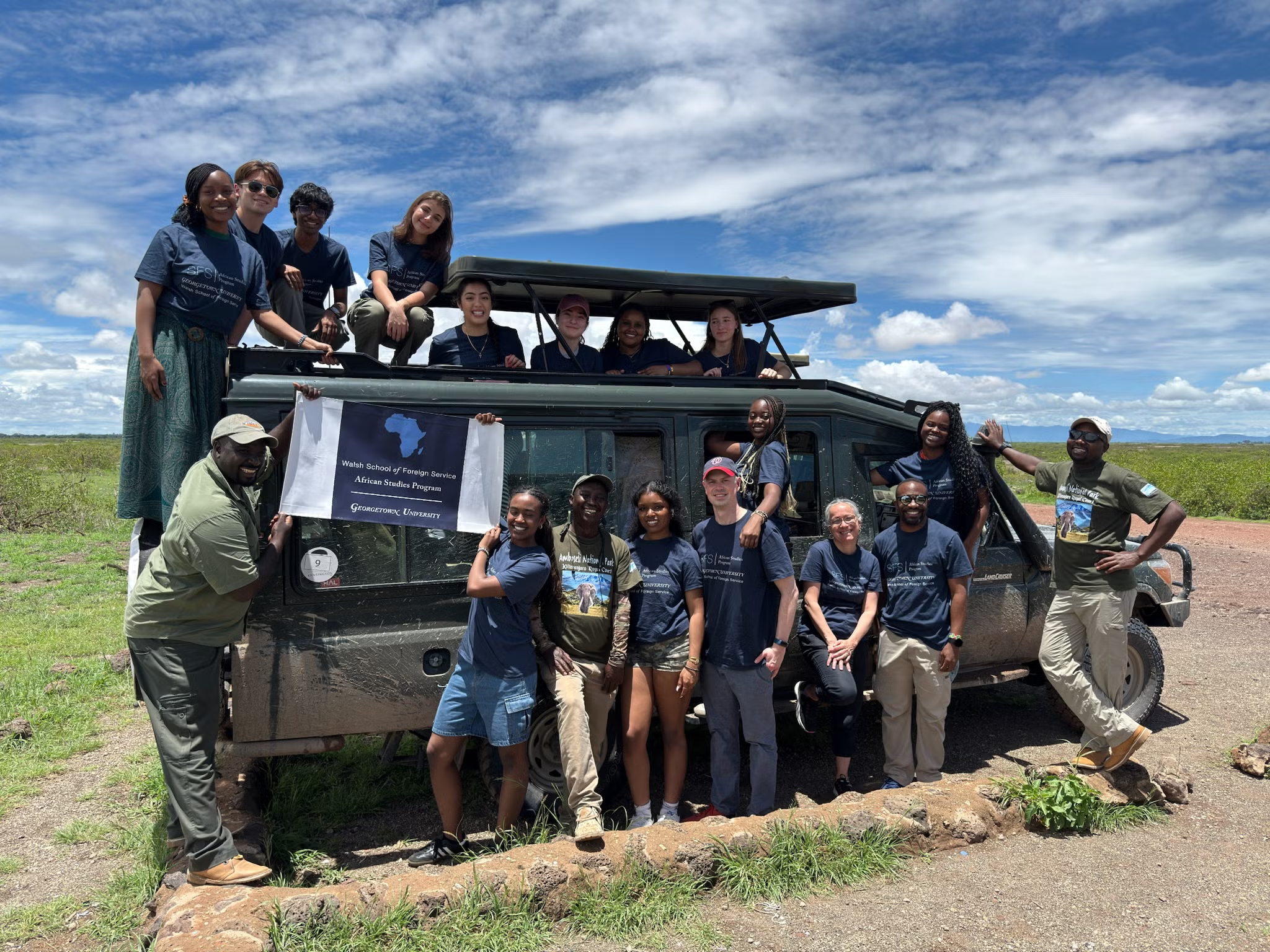
As the students visited government offices and private sector firms like SHOFCO and LVCT Health, Joshua Diaz (SFS’29) noted that the resilience of these organizations was as impactful as their innovation: “The employees we met were still focused on the missions of their organizations and did not overly dwell on the challenges. During our site visits, we found that their operations, though potentially shrunk [by aid cuts], were still functioning.”
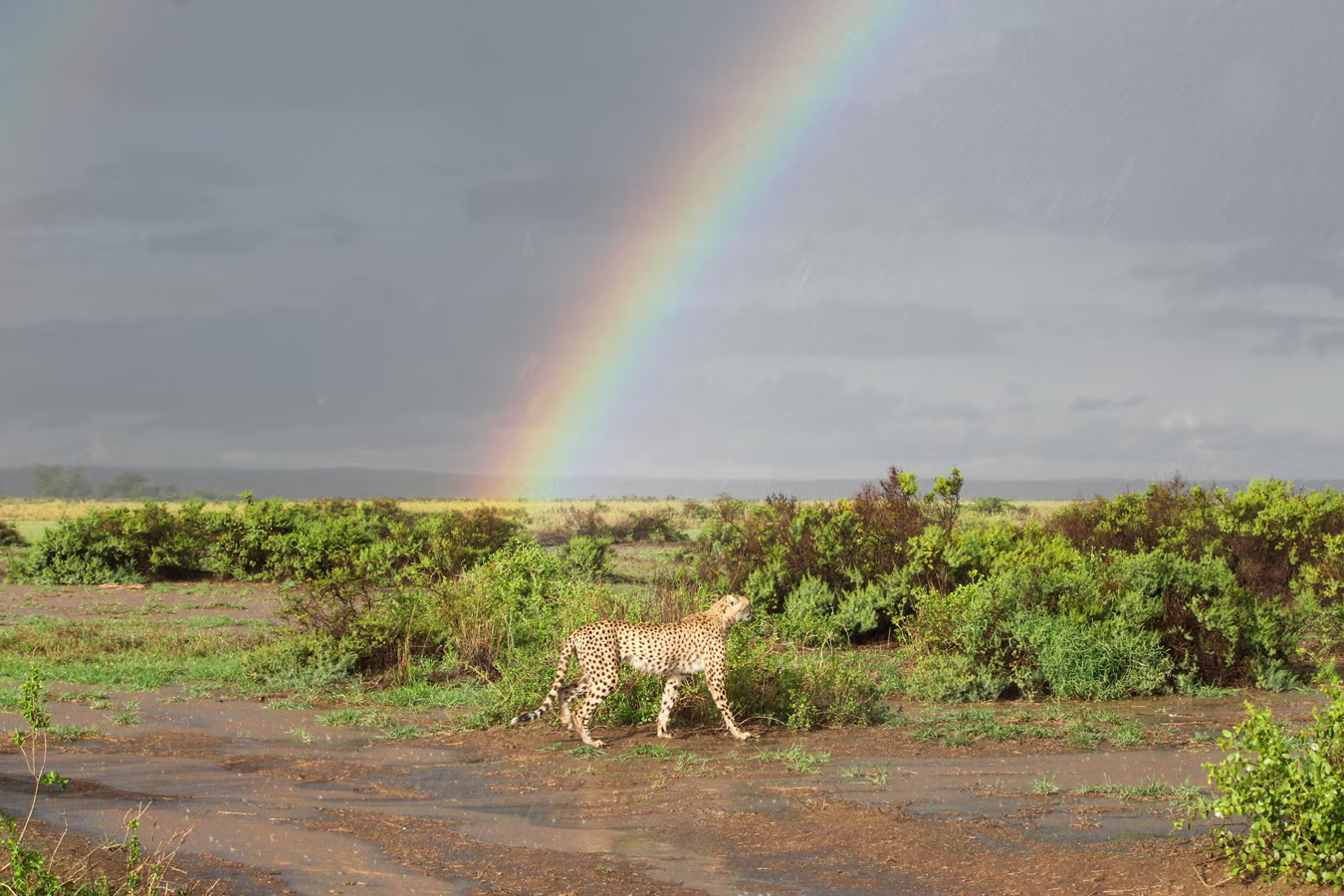
Moments of profound natural beauty served as a capstone to the journey. For Elmostafa, her favorite moment of the entire experience occurred on the very last day in Amboseli National Park. Just as a storm began to clear and a rainbow appeared, the group spotted a cheetah running across the open plain. It was, as she described it, “the perfect closing scene” to a life-altering trip.
Global Organizations and Culture: Dominican Republic
Faculty: Mario Ramirez Basora, Kwame Otu, Michael O’Leary
Students in the Dikran Izmirlian Program in Business and Global Affairs took part in a seven-day, on-location international experience in the Dominican Republic as part of one of their required signature courses, Global Organizations and Culture. This immersion experience is designed not only to add nuance to the curriculum’s abstract models and theories, but also to give students an opportunity to bond as a cohort before exploring the remainder of the Dirkan Izmirlian Program.
During the trip, led by Professor Mario Ramirez Basora, managing director of the Dikran Izmirlian Program, students engaged with local community leaders, NGO representatives and multinational businesses, as well as community members. The immersion experience focused on examining the complex relationship between the Dominican Republic and Haiti, how cultural and historical factors impact Dominican communities today and how local stakeholders are affected by domestic policy and international factors.
Through a series of community visits, panel sessions and local events, students engaged with local businesses and culture and connected their classroom concepts to economic, social and political issues in the Dominican Republic. Among other locations, students visited the Dominican-Hatian border, including stops at the Binational Market between the nations on the border between the towns of Dajabón (DR) and Ouanaminthe (Haiti), multinational corporations in the CODEVI free trade zone as well as the Consorcio Azucarero Central. They also participated in conversations with community members, including a binational panel in the border town of Jimani with guests such as the regional head of the General Directorate of Migration of the Dominican Republic.
Heritage and Development in the Arab World (Egypt)
Faculty: Fida Adely, Rochelle Davis
This Centennial Lab course provided a focused exploration of how Egyptians engage with their heritage for myriad purposes including cultural meaning, economic growth, tourism promotion and community development.
Students explored aspects of Egypt’s immense cultural heritage through architecture, art, manuscripts, libraries, monuments, poetry, dance and the natural environment. They analyzed how entities like NGOs, governments, the UN and diplomatic missions contribute to its protection and development. Alongside these structures, students engaged with complex issues such as race, class, colorism and settler colonialism, and how all these factors shape heritage understanding.

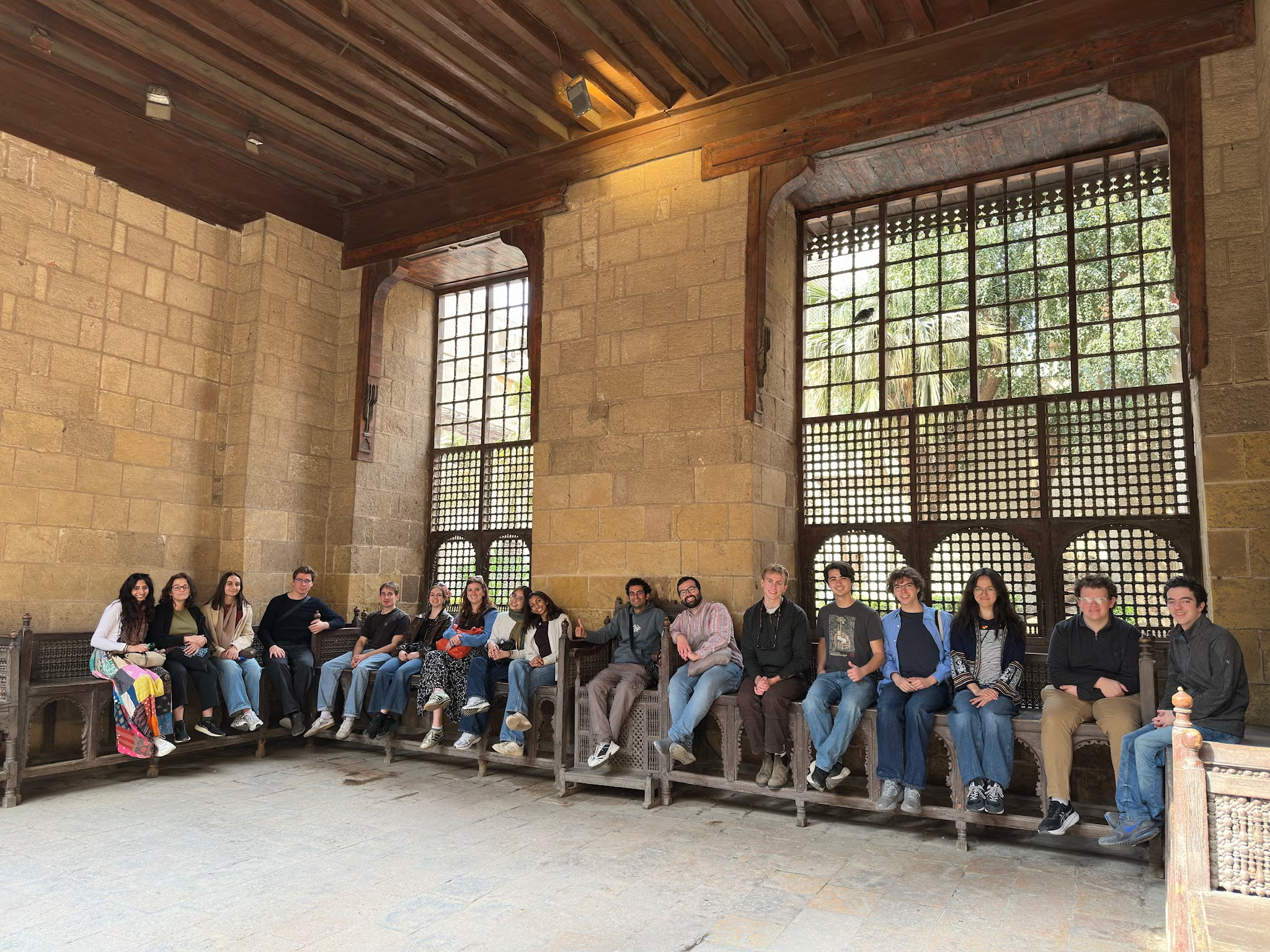
In Cairo, the group took a walking tour of a 1000-year-old neighborhood’s heritage and environmental projects and heard a lecture on the Women and Memory Forum’s successful advocacy for integrating women’s history into education and public awareness. Students also visited handicraft producers who used Egyptian history and culture in their products and attended a Ramadan concert of Nubian music, hosted by the youth-centered Arab Digital Expression Forum.
Minhal Nazeer (SFS’28) highlighted the concert as her favorite part of the trip: “It was an incredible experience to hear the music and dance and feel involved in how Egyptian culture today is truly experienced. Studying Egypt from DC often leaves us observing the content from an external perspective, but this opportunity allowed us to understand our course content firsthand.”
Holocaust Forensics (Romania)
Faculty: Fr. Patrick Desbois, Andrej Umansky
Students in this Centennial Lab traveled to Romania and Moldova to study the little-known “Holocaust by bullets” in Eastern Europe. They were immersed in reckoning with historical accounts of mass crimes and learning the forensic methodologies used to investigate genocide and mass atrocities, all under the guidance of forensic anthropologist Fr. Patrick Desbois and human rights lawyer Andrej Umansky.


Students gained a deeper understanding of mass violence and memory by engaging with Holocaust survivors and witnesses, local historians and current policymakers involved in Holocaust education in Romania and Moldova. They visited significant sites, including the Iasi Holocaust Museum and sites related to the Iasi pogrom in Podu Iloaiei and Targu Frumos.
Sasha Wolfson (SFS’28) reflected on learning about forensic investigations and the relevance of these methodologies in understanding the world today: “This C-Lab was my first introduction to the study of forensic investigation, specifically through a historical lens, and Fr. Desbois and Professor Umansky were uniquely poised to teach us about the delicate and often misunderstood details of the Holocaust in Eastern Europe. What I will remember most is the physical and emotional experience of visiting these sites of mass atrocity and considering how genocidal tactics of the past are being repurposed in the present moment.”
Istanbul: The Many Lives of an Imperial City (Türkiye)
Faculty: Mustafa Aksakal, Sylvia Önder
In this course, students explored the political and cultural history of Istanbul as an imperial capital from Byzantine times through the Ottoman Empire and its transformation into Europe’s largest city under the modern Turkish Republic. The historical primary sources, film, fiction, music, memoirs and relevant secondary sources that students investigated in the classroom came to life in the field.
In Istanbul, students visited both historical and contemporary cultural sites. In addition to dialogue sessions with students at Koç University, they visited preeminent sites of historical memory-making in the Old City imperial complex including Topkapı Palace Museum, Hagia Sophia and the Blue Mosque.
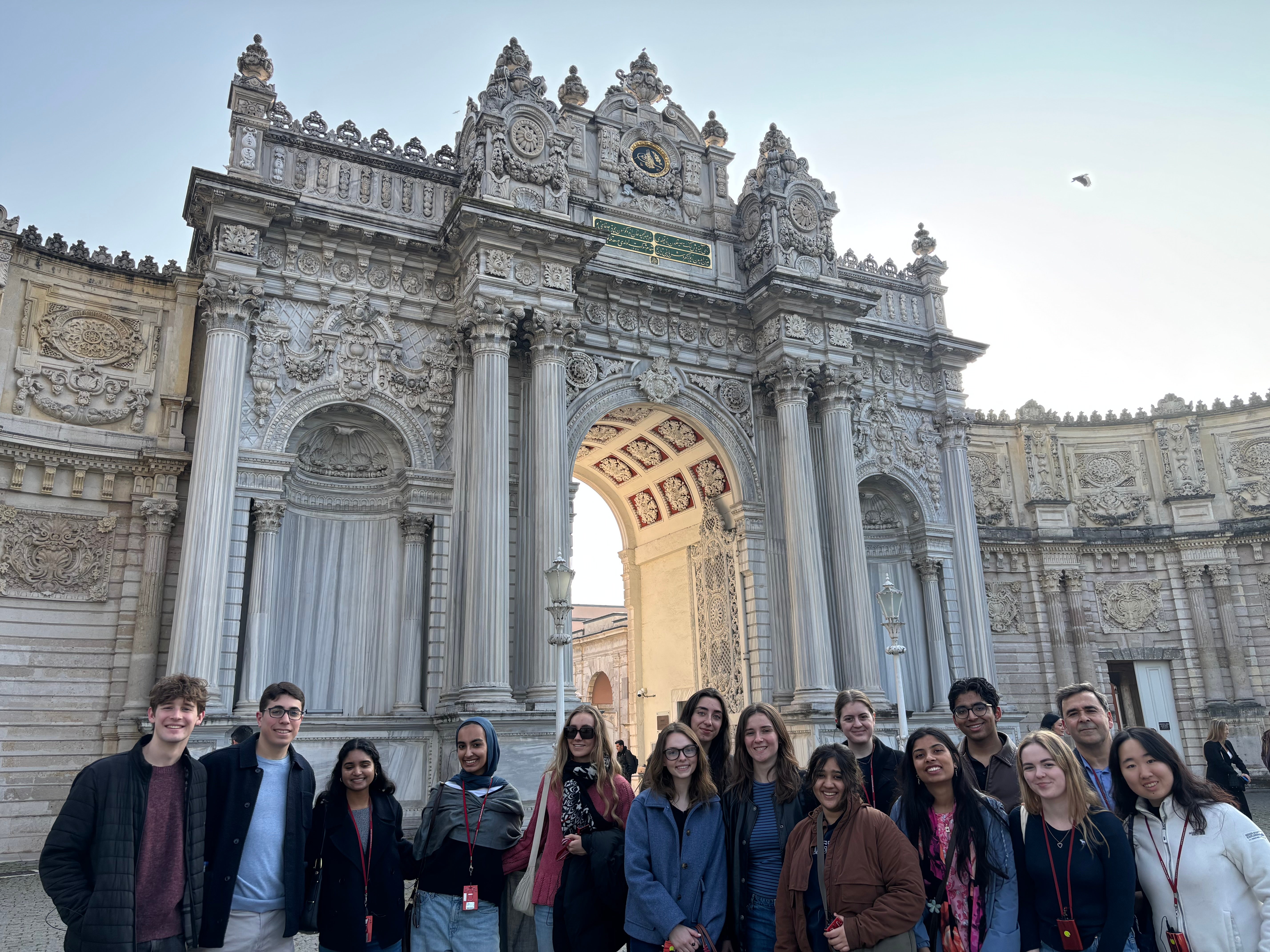
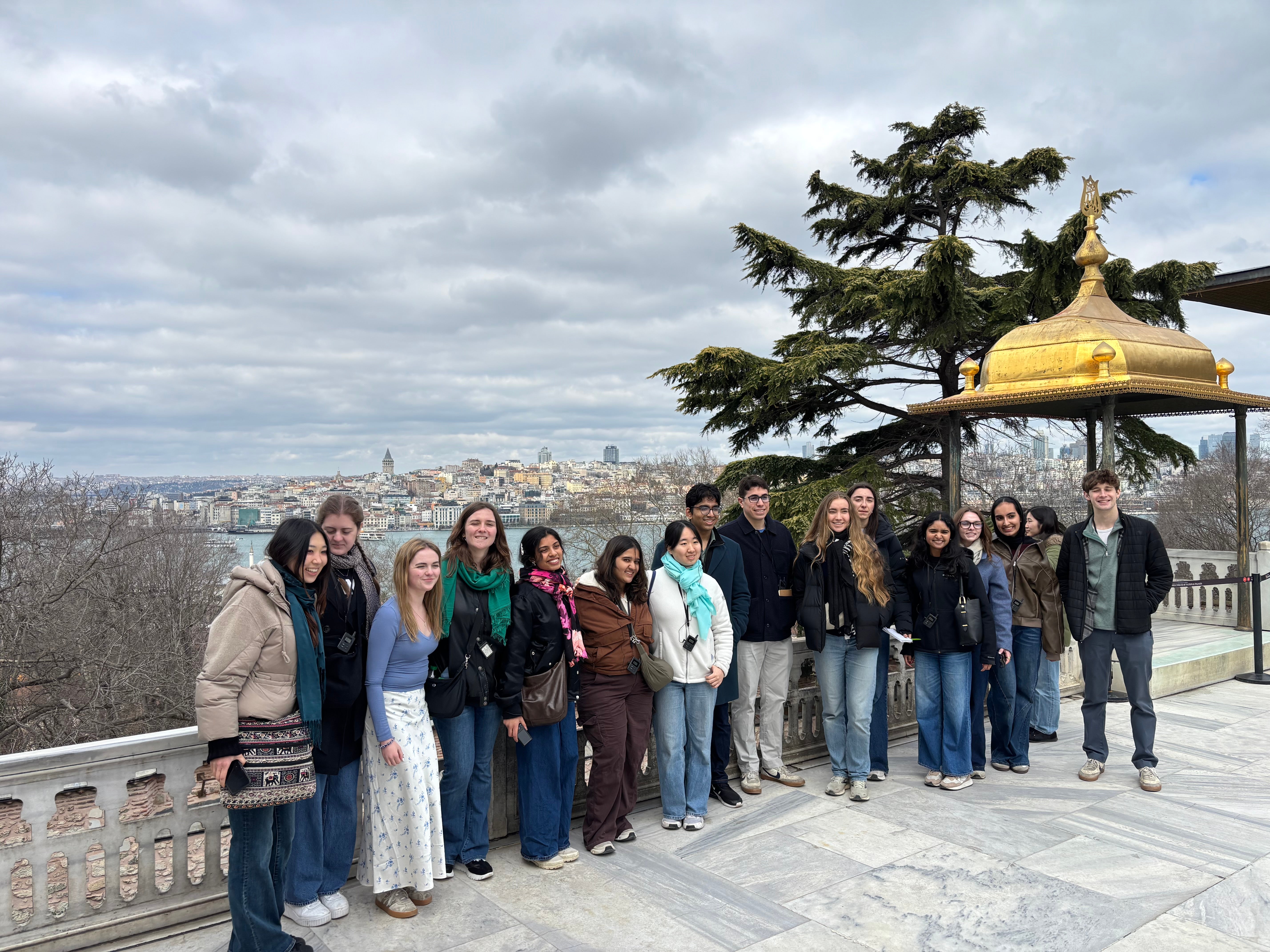
They explored houses of worship—churches, mosques and synagogues—on both the European and Asian sides of the city and visited leading academic and cultural institutions, such as the Süleymaniye Library, the Pera Museum, the Archaeological Museum, and the Museum of Turkish and Islamic Art.
For Daniel Greilsheimer (SFS’26), walking through centuries of history not only illuminated course concepts, but also fostered personal discovery:“My grandma’s family emigrated from the Ottoman Empire in the late nineteenth century after [earlier generations fled] the Inquisition in Spain in 1492, and in our site visits to the synagogues of Istanbul, it was amazing to learn about the history of Jews in Anatolia and connect with my familial past,” he shares. “Visiting Türkiye was something I have long wanted to do, and it is hard to put to words how meaningful the experience was.”