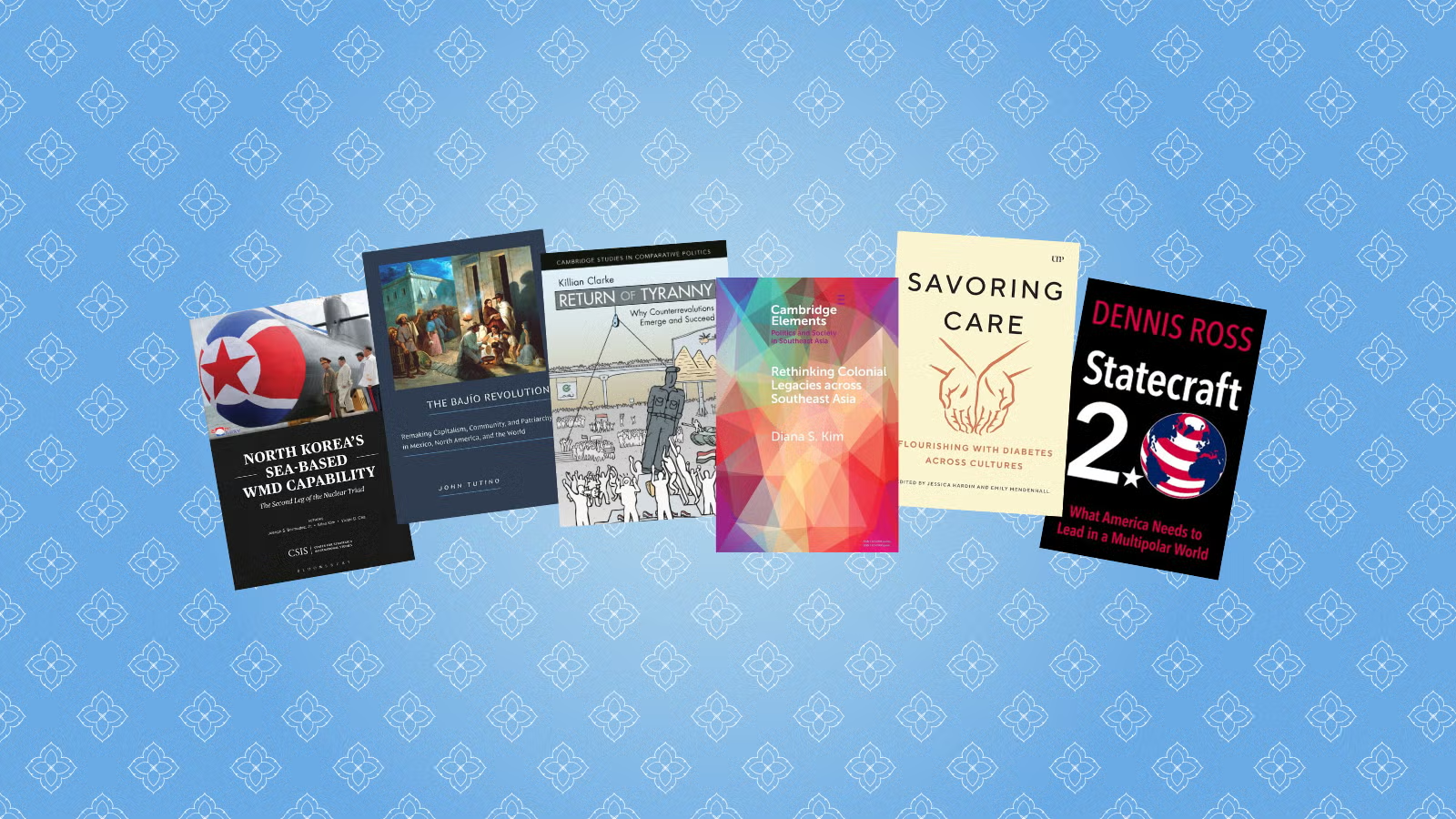
Faculty members at the SFS published a variety of books in 2025 that spanned academic disciplines and unique global issues. Their works cover topics from global power dynamics to public health. As global challenges grow ever more complex, SFS professors remain committed to producing high-quality research that advance new, globally relevant analysis and ideas.
“North Korea’s Sea-Based WMD Capability”
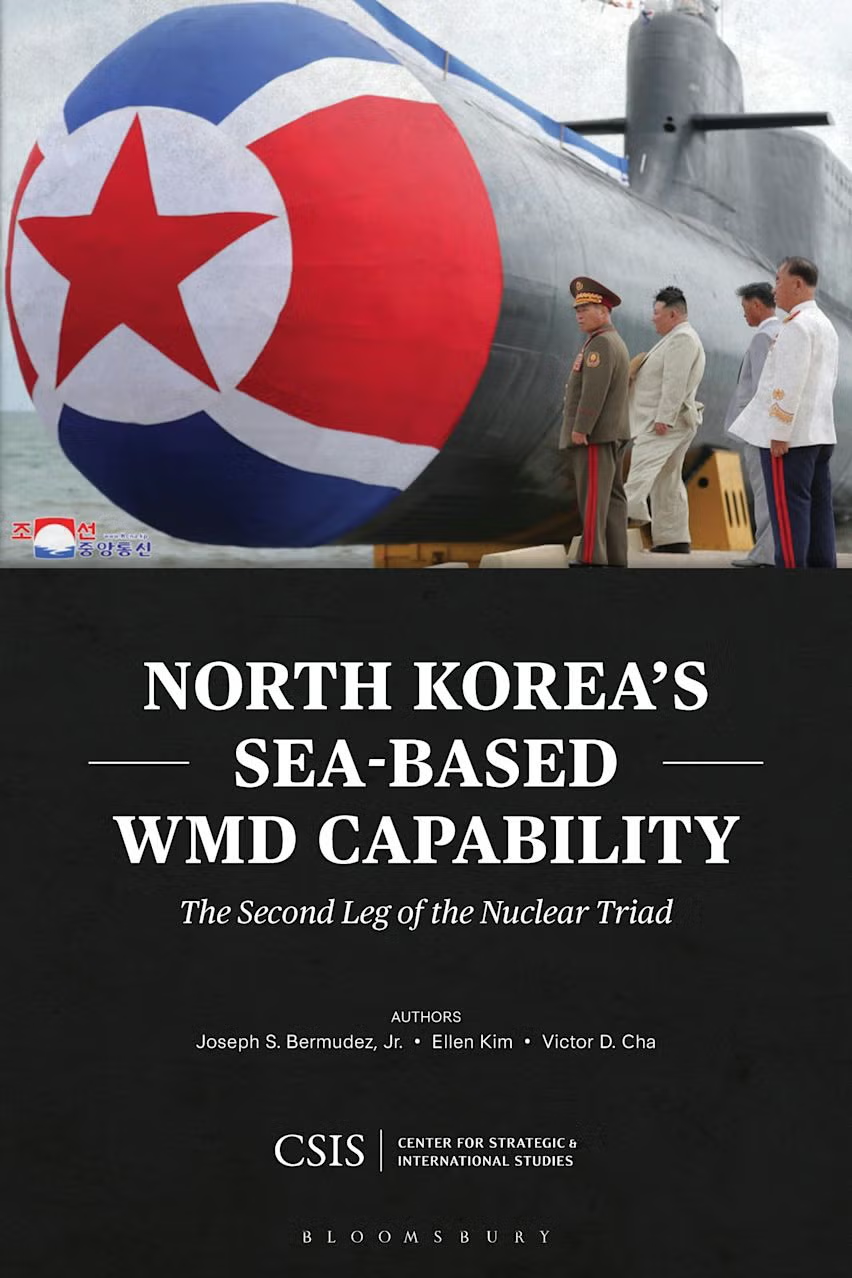
Victor D. Cha, Distinguished University Professor, D.S. Song-KF Chair, and professor of government in the School of Foreign Service and department of government, offers a definitive study of North Korea’s ballistic missile submarine and submarine-launched missile programs in his new book, “North Korea’s Sea-Based WMD Capability.” Along with his co-authors, Joseph S. Bermudez and Ellen Kim, Cha argues that, based on the ongoing development of North Korean submarine forces and sea-based ballistic missile capabilities, the country may be striving to achieve the second leg of the nuclear triad. If this endeavor is successful, it will enable North Korea to boast a survivable nuclear weapons force, posing a new national security challenge to the United States. With the first-ever linguistic analysis of North Korean doctrine, this detailed study fills in crucial information and intelligence gaps regarding the nation’s nuclear capabilities and their origins. The book employs an unprecedented data-scraping linguistic text analysis experiment, spanning 26 years of North Korean statements and documents in a comprehensive examination.
“Return of Tyranny: Why Counterrevolutions Emerge and Succeed”

SFS Assistant Professor Killian Clarke published his first book, “Return of Tyranny: Why Counterrevolutions Emerge and Succeed.” Clarke explores questions of revolutions and counterrevolutions, examining why some revolutions fail while others go on to establish stable rule. He utilizes original data on worldwide counterrevolutions since 1900, emphasizing the strategies revolutionary leaders employ both during their campaigns and after they gain power. Clarke argues that movements espousing radical ideologies and waging violent resistance tend to establish regimes that are difficult to overthrow, while democratic revolutions are far more vulnerable. Despite this conclusion, Clarke identifies a path by which even democratic revolutions can avoid counterrevolution, preserving their elite coalitions and broad popular support to avoid threats. In a context where authoritarianism is resurging worldwide, “Return of Tyranny” analyzes a particular and critical strand of violent reactionary politics.
“Rethinking Colonial Legacies Across Southeast Asia”
In “Rethinking Colonial Legacies across Southeast Asia”, Diana Kim, associate professor in the School of Foreign Service, explores the significance of the Japanese wartime empire’s occupation of Southeast Asia during World War II and examines the occupation through the lens of the region’s colonial legacies. Kim presents the occupation as a critical juncture in mediating the survival of both American and European colonial institutions, comparatively describing how a wide variety of formal institutions for governing territories and people operated under the Japanese between 1940 and 1945. She analyzes the ways in which the Japanese regime selectively kept or changed the existing arrangements of Western predecessors, sometimes introducing new systems altogether. Kim argues that the Japanese occupation generated distinctly different processes for transmitting pre-1940 colonial institutions into an independent Southeast Asia post-war. “Rethinking Colonial Legacies across Southeast Asia” examines Japanese colonial legacies in depth and fundamentally grapples with the idea of what constitutes a meaningful rupture to historical continuity.
“Savoring Care: Flourishing with Diabetes Across Contexts”

SFS Professor Emily Mendenhall, director of the Science, Technology, and International Affairs (STIA) program, and her Rochester Institute of Technology colleague Jessica Hardin are editors of “Savoring Care: Flourishing with Diabetes Across Contexts,” which analyzes how societal beliefs about living with chronic illness shape the way we approach treatment and care.The book challenges dominant narratives about living with Type 2 diabetes and explains how care for the condition is often infused with individual blame and attempts to foster biomedical control. Hardin and Mendenhall aim to shift the focus away from a culture of shame and stigma to a celebration of the ways people living with chronic illness foster care, resilience and well-being. “Savoring Care” explores the forms of practical care that individuals and communities use to support one another, going against the concept of diet and personal responsibility as the sole factors in diabetes management. As they draw on rich ethnographic research, the two authors shed light on how communities respond creatively to diabetes diagnoses and develop nourishing practices that prioritize relationships, friendship and mutual care. Ultimately, the book is both a critique of dominant models of health and a celebration of alternative logics and the diverse, meaningful ways in which people adapt to live well and intuitively understand their own bodies.
“Statecraft 2.0: What America Needs to Lead in a Multipolar World”

In “Statecraft 2.0: What America Needs to Lead in a Multipolar World,” Dennis Ross, Dermont Family Distinguished Professor of the Practice at the Center for Jewish Civilization, explores the repeated failure of blending objectives and means in American foreign policy. Ross uses historical examples to illuminate factors such as political pressures, weak U.S. understanding of target countries for intervention, changing objectives and over-reliance on American action that discounts the aid of allies and partners. He examines case studies to closely inspect the circumstances in which American administrations have both succeeded and failed in marrying objectives and means. He comparatively analyzes what he sees as good cases of statecraft, such as German unification in NATO, and bad cases of statecraft, such as the Obama policy towards Syria. Using this analysis, he develops a framework for creating a modern approach to U.S. policy toward China, Iran and the Israeli-Palestinian conflict. In “Statecraft 2.0,” Ross looks toward the future, explaining how a smart and strategic statecraft approach would shape policy toward the new national security challenges of climate, pandemic and cyber.
“The Bajío Revolution: Remaking Capitalism, Community, and Patriarchy in Mexico, North America, and the World”

John Tutino, professor in the School of Foreign Service and the department of history, examines how popular insurgencies in nineteenth-century Mexico reshaped regional societies, North American power and global capitalism in his new book, “The Bajío Revolution: Remaking Capitalism, Community, and Patriarchy in Mexico, North America, and the World.” He argues that the Bajío uprising disrupted New Spain’s silver-based economy, triggering far-reaching changes in global trade and industrial development. As Mexico moved toward independence, local family producers—especially women—played central roles in sustaining communities and rebuilding economic life. Tutino shows how these transformations briefly positioned Mexico as a potential leader in a new form of industrial capitalism, before expanding U.S. territorial power and global financial systems redirected wealth and opportunity northward. By linking local struggles to global economic shifts, the book offers a new framework for understanding the nineteenth century and the enduring legacies of the Bajío Revolution.