Lee Schlenker (MLAS’26) took a less conventional path to graduate school. After graduating from Middlebury College in 2016, he wanted to return to school after a short break, but the COVID-19 pandemic and years spent working for non-governmental organizations and media outlets in Latin America extended that plan by almost a decade. It was only when his professional trajectory began to feel stalled that he started seriously reconsidering grad school. He hoped to learn more about Colombia, Venezuela, Ecuador and the Caribbean, countries often overlooked in the study of Latin America.

By the time he began exploring programs, Schlenker was already familiar with Georgetown University and SFS, and he knew the Center for Latin American Studies’ reputation as one of the oldest and most prominent programs of its kind in the U.S. But it was after meeting Professor Angelo Rivero Santos, CLAS Academic Affairs Director, that he knew Georgetown was the right fit.
Schlenker had initially reached out to Rivero Santos not as a prospective student, but as someone seeking expertise for a previous job.
“He has a signature in his email that says, ‘We encourage you to apply,’ and at first I thought it was personalized,” he says of the email Rivero Santos sent before their meeting, later realizing it was part of a standard signature sent to everyone. “But after we met, he did tell me, ‘You should really apply. You’d be great.’”
Thanks in part to Rivero Santos’ support and encouragement, Schlenker will walk across the stage this May with a Master of Arts in Latin American Studies and a far deeper understanding of the region—one shaped by mentors, classmates and the many academic and professional opportunities he found at Georgetown.
Where Colombia became an academic focus
A native of Newton, Massachusetts, just outside of Boston, Schlenker describes himself as “a product of the Northeast.” He had a clear focus for the program: a deep dive into Colombia. This country was already central to his life, both personally and professionally, given that he had traveled there for work and his partner is Colombian.
“It’s such an important country for the U.S.’s relationship to the region, given it’s such a strong ally on a bipartisan basis with whatever government is in power,” Schlenker says.
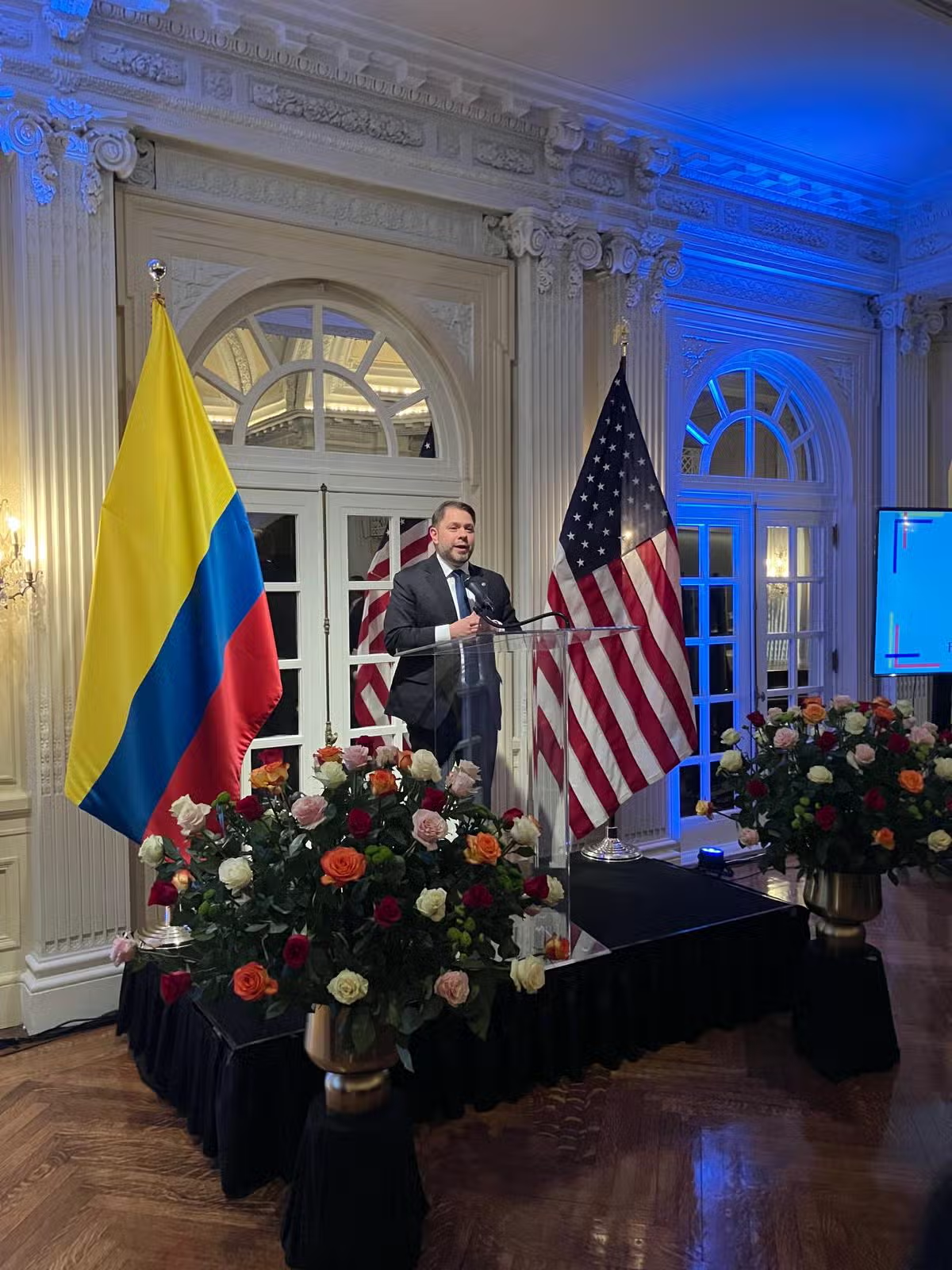
On the Hilltop, he has deepened his sub-regional expertise and expanded his understanding of U.S.-Latin America relations, particularly security and counter-narcotics policy, U.S. foreign assistance and congressional appropriations. During his first semester, as part of a course with Rivero Santos, he completed a country profile on Colombia, which he says served as an important introduction to the country’s economy, political and judicial system, social indicators, tensions, conflicts, history and relations within the region and beyond.
“Every class, I was able to focus on Colombia and different aspects, like the role of international actors in its peace process in 2016, the motivations behind each of those countries’ participation and the outcomes of their efforts in Colombia’s ongoing construction of peace,” he says.
That sustained focus has helped shape the capstone project he’s now finishing. Schlenker began work in fall 2025, and his work on the capstone has required him to dive into both the literature and theory behind non-militarized supply-side counter-narcotics strategies while also taking a quantitative approach to evaluating which policies have been the most effective over the past 25 years. His capstone is slated to be published as a policy brief for the Quincy Institute, he shares.
When asked about the mentors and advisors who have had a significant impact on his time at Georgetown, he was quick to credit Rivero Santos, who Schlenker says has always been accessible even during the months leading up to the start of the program. Schlenker has taken three classes with Rivero Santos, including one on regional integration and international relations in Latin America.
“We had maybe eight students, but basically every class had a high-level practitioner or diplomat from the Caribbean, from Bolivia, from Mexico, from the U.S, who had served in the National Security Council,the intelligence community and elsewhere,” Schlenker says about the class. “We had unparalleled access because of Angelo’s past experiences as a diplomat himself and his great network. And it made for some of the best, most stimulating discussions that I had in class.”
Bringing Latin America experience to the Hilltop

That foundation of mentorship and intellectual exchange built on interests Schlenker had been developing long before he arrived at Georgetown. Before starting the program, he had already lived in Havana on two separate occasions, first during the Obama administration and the beginning of the first Trump administration, when he worked with Witness for Peace leading authorized people-to-people delegations to Cuba. Schlenker also lived in Mexico and traveled to Venezuela and Puerto Rico through other professional opportunities and spent two and a half years in Boston as Witness for Peace’s regional organizer, helping connect scholars, activists and local institutions in conversations about U.S.-Latin America relations.
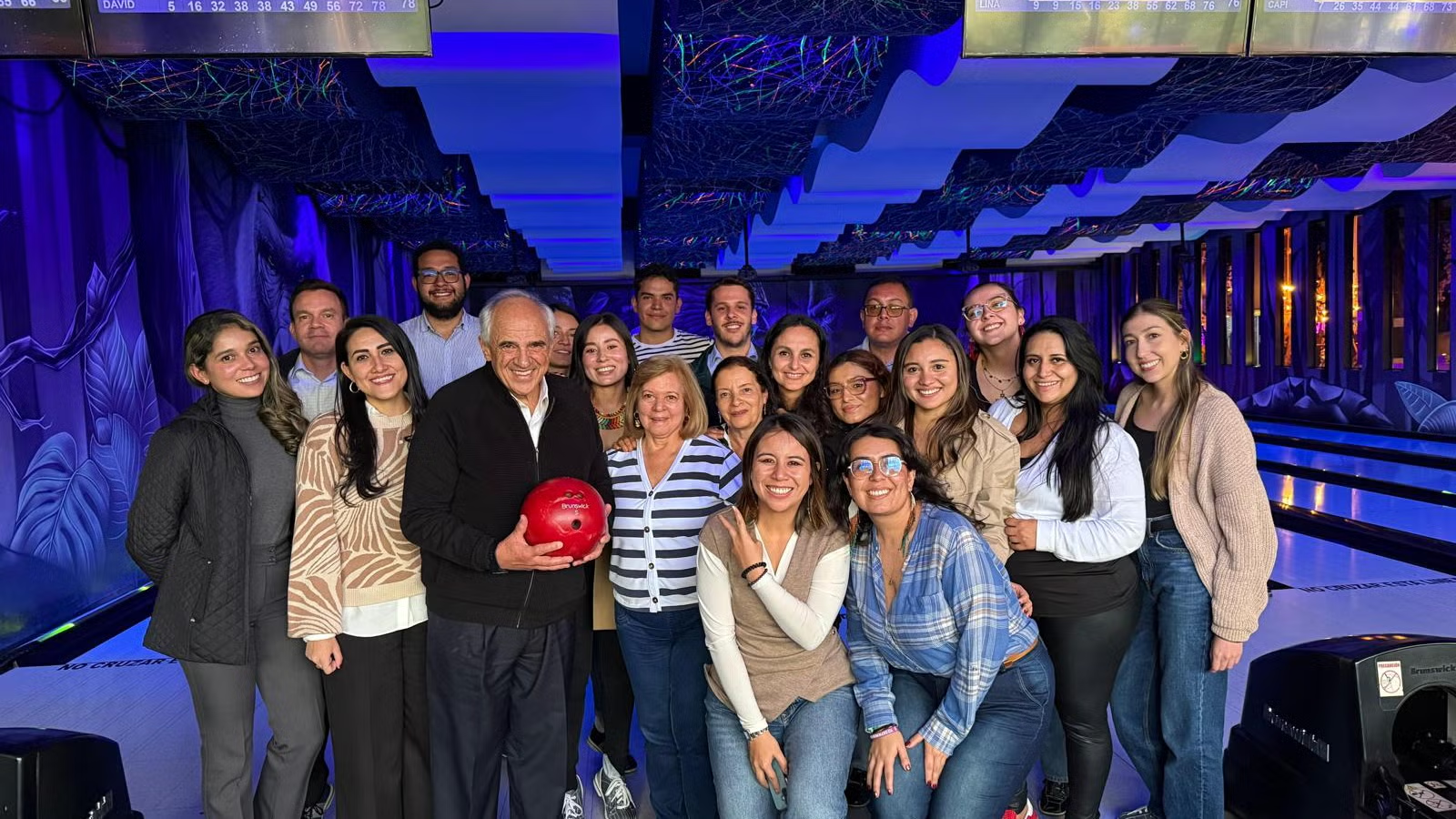
Over the past two years, he has also had the opportunity to return to Bogotá for a three-month internship at the foreign policy think tank Corporación Escenarios. Founded by Ernesto Samper Pizano, former president of Colombia and former secretary general of the now-dormant Union of South American Nations, the organization works to promote regional integration in Latin America. During his time in Bogotá, Schlenker worked on public reports, including one on the European Union’s November 2025 summit with the Community of Latin American and Caribbean States (CELAC).
“I got to engage with a number of Colombian officials, civil society leaders, preeminent scholars and just wonderful coworkers who really helped open my eyes to life in the country and some of the ongoing political and security challenges,” he says.
Back on the Hilltop, Schlenker makes a point to stay engaged with the Center for Latin American Studies’ programming. He regularly attends the CLAS Ambassador series, where he hears from diplomats and officials from countries including Brazil, El Salvador, Colombia and Costa Rica. Last year, he also attended the full Georgetown Americas Institute series on U.S. national security and Latin America.


Carrying the commitment to Latin America beyond Georgetown
As graduation approaches, Schlenker says he’ll miss his professors and intellectually rigorous cohort most.
“There’s just nothing like having 20 other students who are really passionate about these issues, who have gone through the same courses as you, share the same inquiries, doubts and questions and can really push you on what you’re saying, writing and thinking,” he says.

Schlenker hopes to help shape conversations in Washington around the region through research, reporting and advocacy, and push back against overly securitized approaches to its most pressing challenges. Looking back, he encourages incoming students to take full advantage of everything Georgetown has to offer and establish those intellectual communities that will shape their time in the program and beyond.
“You won’t regret joining this program,” he says. “It will be an unimaginable boost to your career, your confidence and your ability to project expertise about the issues that you’re passionate about.”