Postdoctoral research serves as a vital pillar of a university’s academic ecosystem. As temporary scholars conducting full-time investigations following the completion of their doctorates, postdoctoral fellows bridge the transition from student status to independent careers in academia or industry.

Professor Joanna Lewis, vice dean of undergraduate affairs in the School of Foreign Service (SFS), has spent several years mentoring postdocs at Georgetown through SFS’s Science, Technology and International Affairs (STIA) Program. Dedicated to preparing future leaders at the intersection of science and policy, STIA fosters innovative research to address complex global challenges.
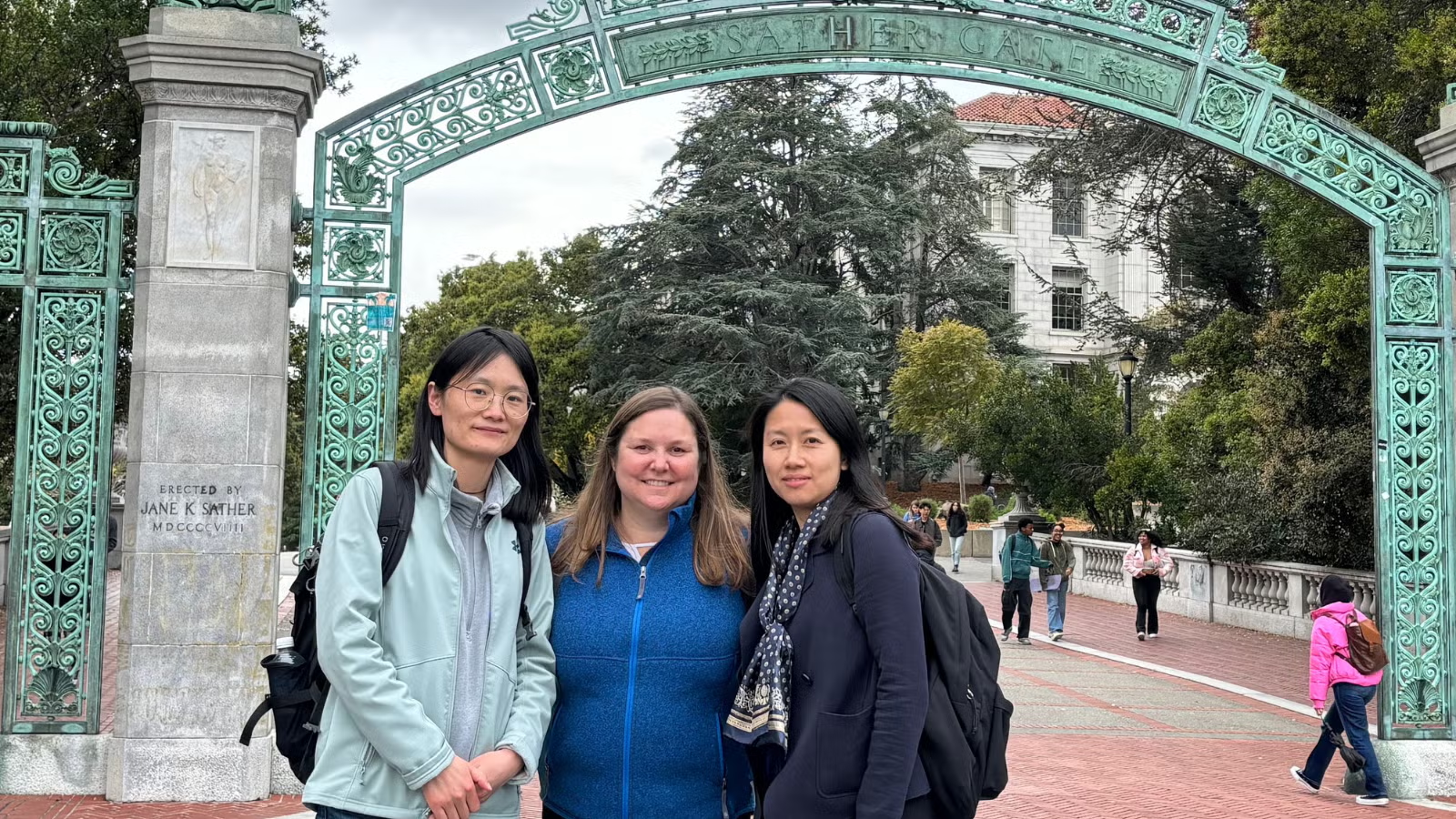
Lewis recently published three scholarly papers, each co-authored with one of her three most recent Georgetown postdoctoral fellows. Together, these publications examine distinct facets of energy, climate policy and China’s global role in these sectors. We spoke with Lewis and her former fellows to explore their findings and reflect on their collaborative mentorship experience.
Collaborative scholarship on a changing China

With over twenty years dedicated to researching Chinese climate politics, Lewis’s academic work has expanded from studying domestic decarbonization and renewable energy adoption to examining China’s expanding influence across international clean energy supply networks.
“China has really risen to become a leader in this space. It now is actually the country with the most solar energy, wind energy and a variety of other low-carbon energy sources. They also manufacture these technologies now for the rest of the world,” Lewis says.
In their paper “China in Twenty-Five Years of Global Environmental Politics: The Case of Climate Diplomacy,” Lewis and co-author Xiaoli Zhang (2023-2025) examine how China’s role in global climate politics evolved over two and a half decades, looking specifically at how international climate frameworks intersected with domestic energy and economic priorities.
Zhang earned her Ph.D. from Renmin University of China in Beijing, modeling power systems for her dissertation on China’s energy transition pathways and their economic and employment impacts. At the Centre for Research on Energy and Clean Air, she analyzes policy, clean energy, fossil fuels and air quality synergies.
Zhang notes that her Georgetown postdoctoral fellowship with Lewis helped her expand beyond her technical background, bridging China’s energy and climate policies with broader themes of political economy, international relations and geopolitics.
“As clean-energy technologies advanced, I came to see that technological possibility alone does not determine the pace of the transition. Policy, institutions and cooperation between countries are just as important,” Zhang says.
That intersection of policy and international cooperation is central to the work of Weila Gong (2021-2022). Holding a Ph.D. in political science from the Technical University of Munich, Gong brought a rich background in international relations and environmental policy—including work with the California-China Climate Institute and Lawrence Berkeley National Laboratory—to Georgetown.

Gong’s recent co-authored paper with Lewis, “The politics and policies governing China’s coal transition: implications for climate mitigation,” examines the challenges and opportunities of accelerating equitable, low-carbon energy transitions amid rising geopolitical tensions. Gong and Lewis had previously authored a paper in September 2024 exploring how prioritizing capital allocations over workforce support can hinder coal-dependent workers and regional communities from achieving an equitable transition away from coal.
“The fellowship helped me move from studying climate politics primarily as a political scientist to thinking much more broadly about how political institutions, energy policy and international engagement interact in shaping clean energy transitions,” Gong says.
Fostering DC connections and two-way learning
Integrating postdoctoral fellows into both the Georgetown academic community and the broader Washington, DC, policy landscape is one of the aspects of the program Lewis finds most rewarding. She encourages them to actively engage with local think tanks, NGOs and government officials.

For fellows like Jiaqi Lu (2023-2024), this environment proved invaluable. “During my time as a postdoc, Georgetown provided a platform for exchange with scholars from all-over the world,” Lu says. “I enjoyed the opportunities to attend conferences and workshops both on and off campus.”
Lu earned a joint Ph.D. in political science and environment and resources from the University of Wisconsin-Madison. He is now an assistant professor in the Thrust of Carbon Neutrality and Climate Change at the Hong Kong University of Science and Technology in Guangzhou. His research focuses on global climate and energy policy, with his dissertation examining China’s climate policy network and how domestic and international actors influence policy decisions.
The idea for his co-authored paper with Lewis, “Networking for the climate: international climate actors in Beijing,” grew from exposure to experts, stakeholders, policymakers and international climate actors. He found climate and energy policy in both the U.S. and China to be a tight-knit circle, where well-connected actors exchange and spread ideas to shape concrete policy. He notes that Lewis’s guidance was instrumental in helping him refine and fully develop this concept.
“My idea about policy networks quickly resonated with her insights about the field. She offered many ideas about the field, and provided feedback and guidance for adopting new datasets for analysis, making the research more comprehensive and real-world relevant,” Lu says.
Beyond producing actionable research on China, climate and energy, Lewis emphasizes that mentorship is a two-way street with each of her postdoctoral fellows that she has worked with.
“Bringing in these scholars gives me new research ideas, and it really can be inspiring to learn from them. They often bring expertise that’s complementary to my background but different, and so that allows us to work on studies that I wouldn’t be able to do alone,” Lewis says.
Welcoming new fellows and shaping policy nuance
Joining Lewis as a postdoctoral fellow for this academic year, Congyi Dai recently earned his Ph.D. in environment and sustainability from the University of Michigan. His doctoral research explores how Chinese development finance and mining acquisitions intersect to influence energy access across Africa.
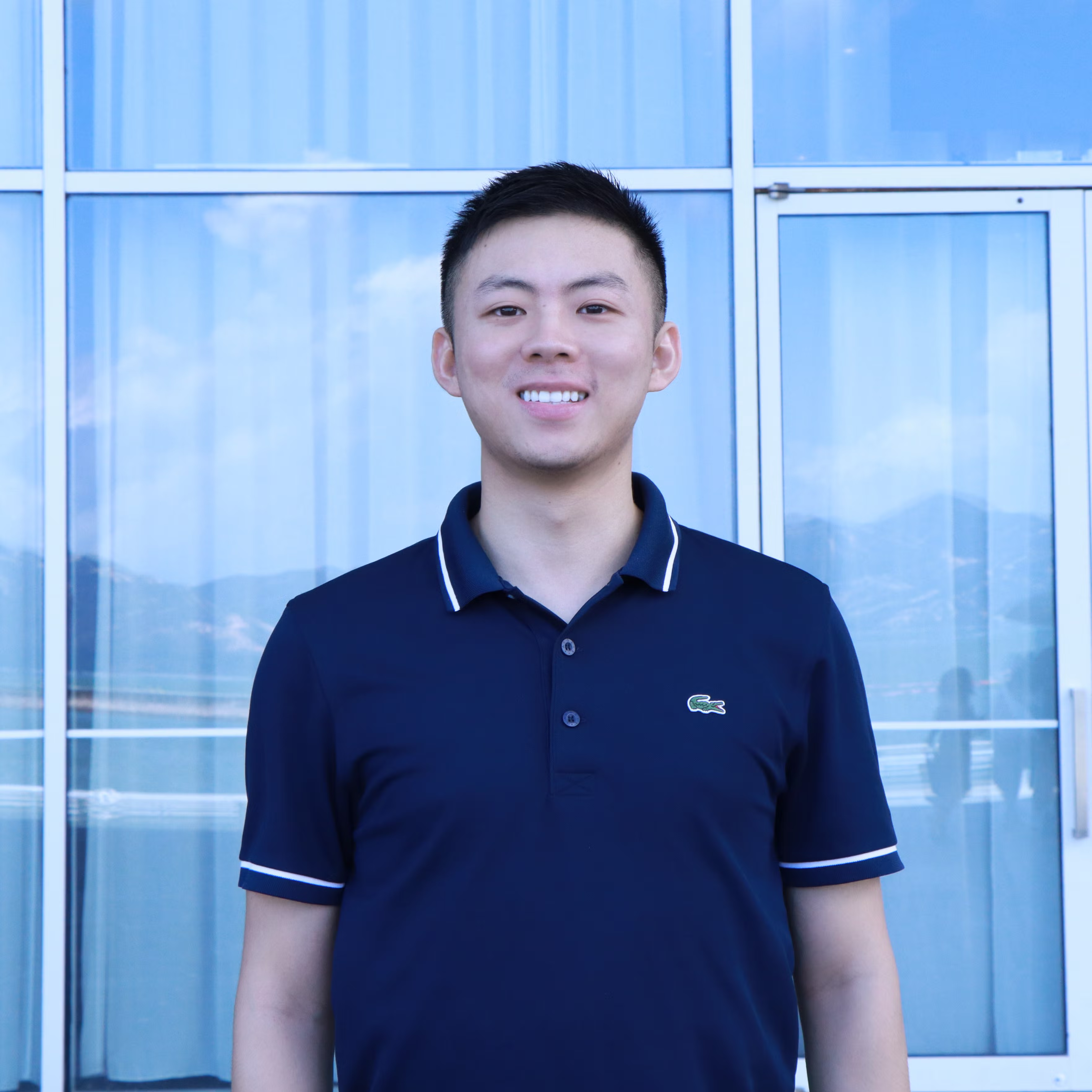
In addition to benefiting from proximity to Washington, DC, and its role as a policymaking center, Dai looks forward to integrating a U.S. perspective into his ongoing research on clean energy supply chains.
“I have been wanting to gain more training on how to better connect research findings to real-life policy implications. Georgetown’s STIA is the perfect place for me to engage with people with deep expertise in science and technology policymaking,” Dai says.
It is precisely this interdisciplinary training that Zhang sees as vital for the next generation of climate scholars. “Climate change now sits at the intersection of technology, economics, development, security and geopolitics. We need people who can work across those boundaries and help translate technological possibilities into effective policy and real-world action,” she says.
Lewis’s hope is that her work with new fellows continues to go beyond national declarations or key leadership statements to analyze dynamics at the provincial and local levels—which can often look very different than conventional media narratives.
“We try to write things that are accessible not just to academics, but to policymakers who are working on these issues,” Lewis says. “And we bring this research to conversations with policymakers as well to try to make sure the U.S. and other countries have a more nuanced understanding of China’s perspectives on these topics.”