
For Australia native Gemma King (MASIA’26), the Master of Arts in Asian Studies (MASIA) program stood out for its blend of academic rigor and experiential learning. As she prepares to graduate this spring, King discusses her path to the program, what she learned along the way and how internships and hands-on opportunities shaped her next steps.
What first sparked your interest in Asia, and how did growing up in Australia, as well as early experiences like studying Indonesian and traveling in high school, shape your academic and career trajectory?
Growing up in Australia within close proximity to Asia, my interest in the region started at a young age. When I was studying Indonesian in high school, the relationship between Australia and Indonesia was complex and even fraught at times. This inspired me to seek out a deeper understanding of the role that politics plays in how countries interact with one another. Going into my undergraduate degree in international relations, there was no question that my regional focus would be Asia, given my personal interest and its intense significance to Australia.
What motivated you to choose Georgetown and the MASIA program specifically? Could you describe your experience during the application process?
Upon graduating with my bachelor’s, I worked at an Australian think tank focused on Indo-Pacific strategy. My research focused on the U.S.-Australia alliance in Asia, looking at how U.S. and Australian policymakers work together to combine their strategic efforts in the region. Spending time working on the U.S.-Australia alliance gave me an appreciation for just how much policymaking in Washington, DC, drives Indo-Pacific strategic dynamics—including influencing how Australia engages with Asia. I became deeply interested in understanding more about these policymaking processes, and when considering grad school, I knew that there would be no better place to be for this than at Georgetown. Georgetown and the MASIA program were the perfect intersection of my interests and priorities, where I could be located in Washington, DC, and learn from world-leading experts on Asia, including professors who have been in the front seat, driving U.S. policy in Asia.

During my application process for Georgetown, I was really appreciative of the MASIA program staff being willing to hop on Zoom calls to answer my questions, in addition to holding prospective student webinars. This kind of flexibility was important to me since I was applying from the other side of the world, so it was a little bit more complicated for me to engage with the program. Between Georgetown’s reputation and the support I received from the MASIA program before I’d even applied, I never had any doubts that SFS was the right fit for me.
As one of the first students to take courses in Jakarta, Indonesia, through Georgetown SFS Asia Pacific, what were some of the most meaningful lessons or moments you experienced?
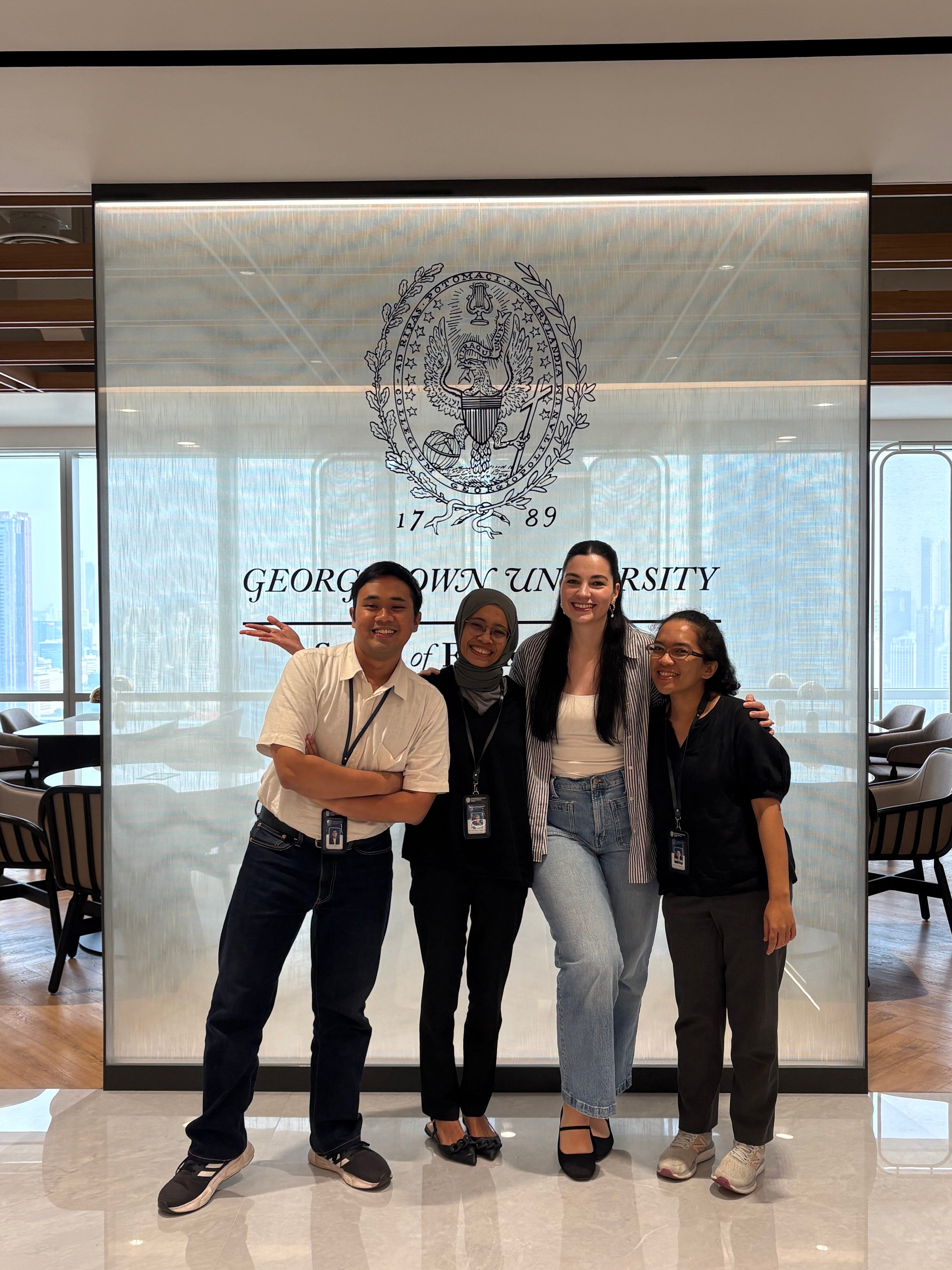
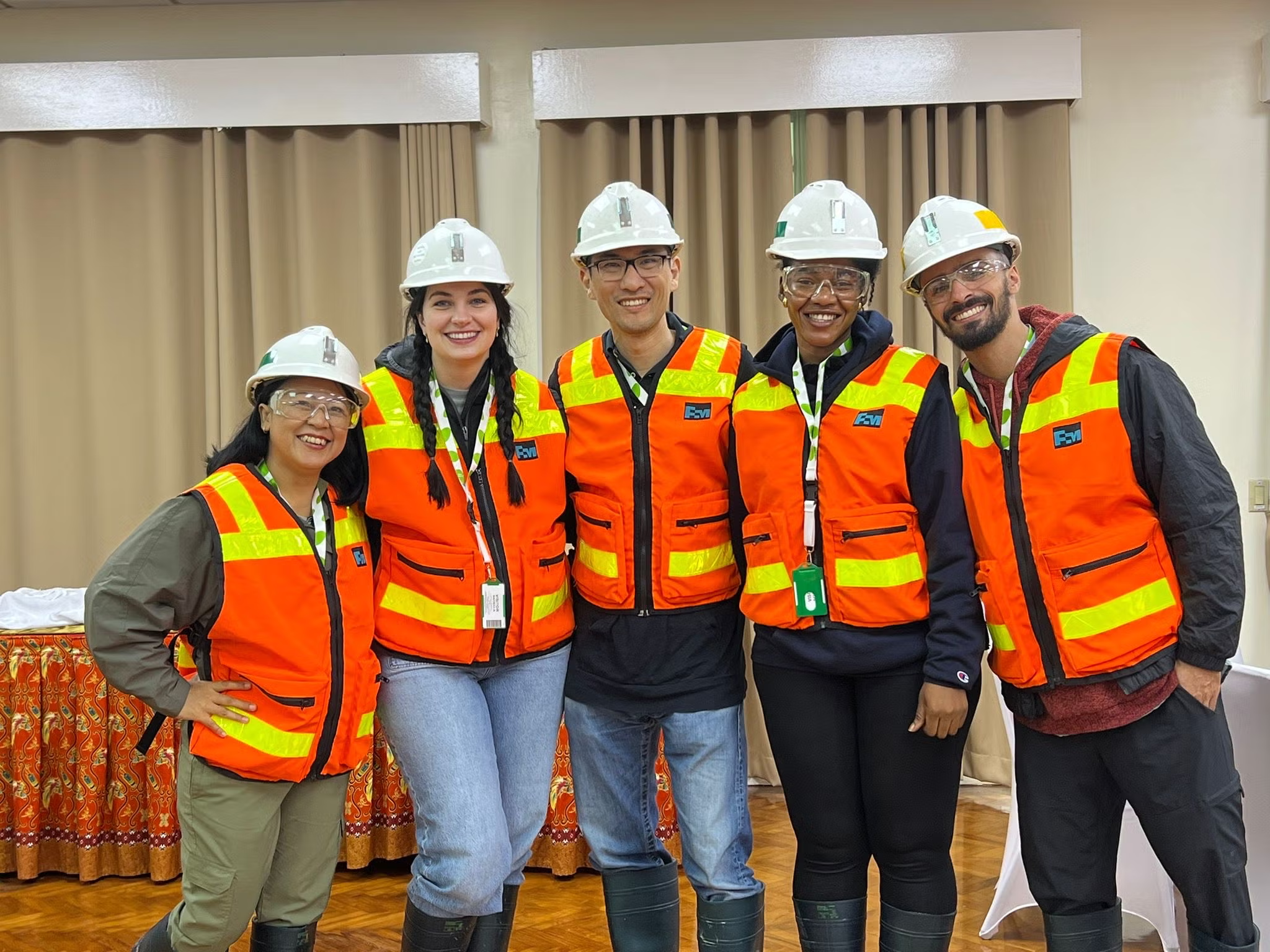
Being at Georgetown SFS Asia Pacific in its early stages over the summer of 2025 was really exciting. The branch location is located in the heart of Jakarta, which is the most populous city in the world. Beyond the beautiful location that overlooks downtown Jakarta, the program exposed me to some invaluable learning experiences in Indonesia. I took a course focused on critical minerals and Indonesia’s mining industry, which included traveling to Papua to visit the world’s largest gold and copper mine—something I never imagined I would get to do during my graduate studies. It gave me an opportunity to learn about the importance of the mining sector to the Indonesian economy, the environmental impacts of mining and the relationship between the American mining company and the Indonesian government. I’m glad I took the opportunity to spend time physically in Asia while undertaking the MASIA program. It gave me a fresh perspective on Indonesia and Asia more broadly, which has helped inform my coursework and it also helped me improve my language skills.
What have been some of the highlights of your time at SFS, and how have you made use of the resources and opportunities available to you?
One of the most significant highlights was being selected to participate in a special seminar with Kurt Campbell, SFS Distinguished Fellow in Diplomacy and former U.S. Deputy Secretary of State. During his time in government, Professor Campbell was instrumental in driving U.S. policy in Asia, including championing the U.S.-Australia alliance. Getting to be in the classroom with him was a once in a lifetime experience where I was able to ask questions firsthand and receive candid responses. For me, the seminar with Professor Campbell gave me a peek behind the curtain at U.S. policymaking and exposed me to the multiple forces at play in the policymaking process—including the personalities driving decisions—which is something that you can’t get from a textbook.
Outside of the classroom, another highlight has been finding a community. The Asian Studies Program is a tight-knit group, and I’ve made some of my closest friends since coming to Georgetown. Going to grad school can be stressful and daunting, especially when you’re moving to a new place. The friends I’ve made in MASIA have made all the difference in my graduate school experience, and I’m very grateful for their encouragement, community and support. Some of the best memories at Georgetown have just been study sessions in the library with my friends, and I’m sure the connections I’ve made here will last long after I’ve graduated.
How have your internships and academic experiences shaped your perspective on U.S.–Australia relations and broader Indo-Pacific policy, and how do you hope to contribute to these fields in the future?

I’ve been fortunate to pursue exciting internships at Georgetown, including at the Center for Strategic and International Studies and at Vriens & Partners, a government affairs consulting firm. These experiences have greatly enhanced my experience living in Washington, DC, because they’ve given me valuable exposure to the DC policy community, which is something I came to Georgetown hoping to gain. These internships have worked hand in hand with my experience in MASIA. They’ve enabled me to apply the theoretical lessons I learn in the classroom to real-world situations, taking my education beyond just reading things on paper towards actually applying them in practice. As I approach graduation, my DC internships combined with my professional think tank experience position me well to enter into a career focused on Indo-Pacific policy with practical skills under my belt.
Ready to take the next step? Learn more about the Master of Arts in Asian Studies and other SFS graduate programs, and apply by January 15, 2026, for priority merit scholarship consideration.