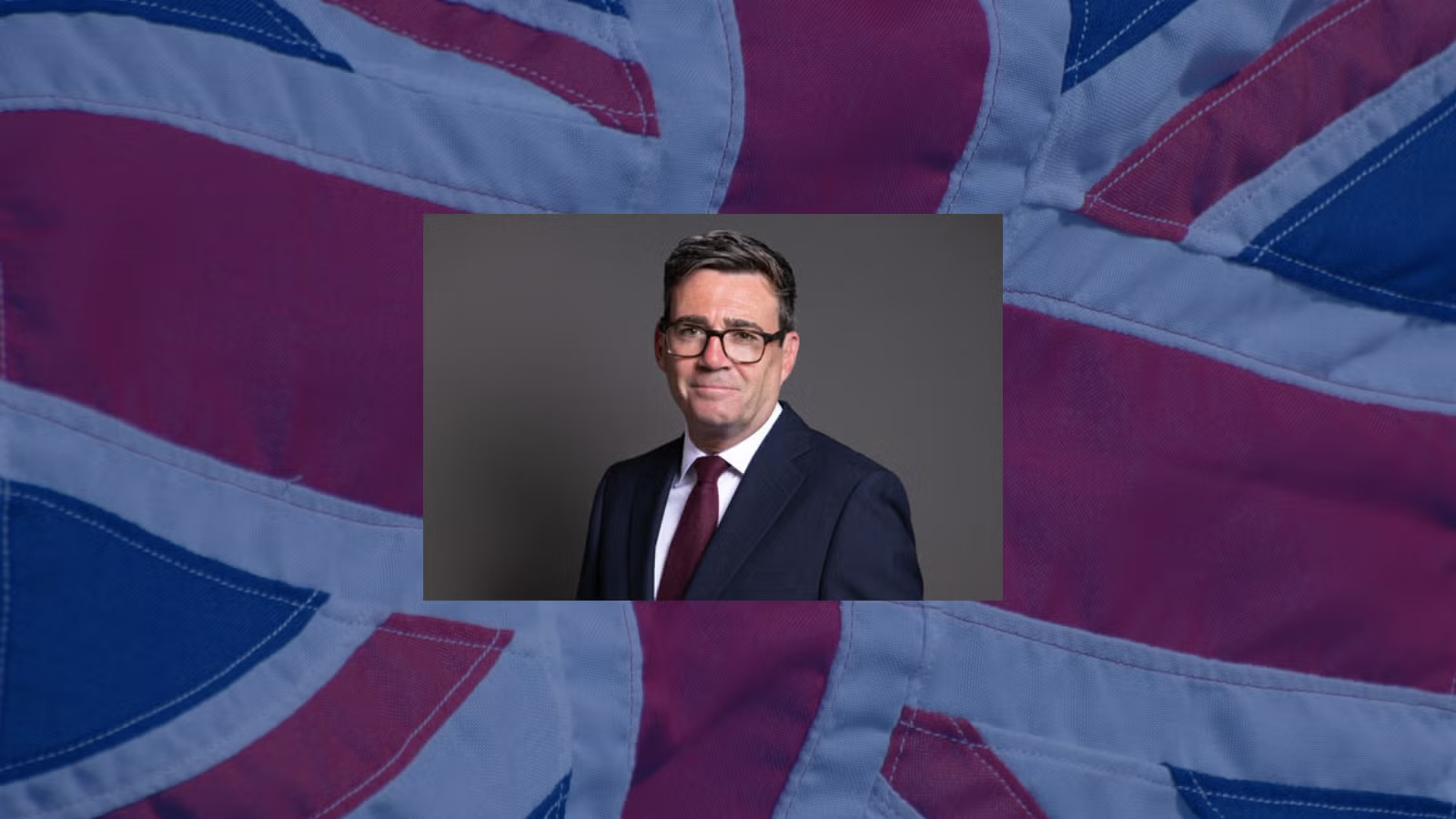
On Monday, July 20, 2026, Andy Burnham became the new prime minister of the United Kingdom. He took over the government from Keir Starmer as the seventh prime minister in the decade since the June 2016 Brexit vote. What factors have led the UK to have such turbulence in the political system, and is the former mayor of Manchester likely to steady the ship? We spoke with Professor Jeffrey Anderson, professor in the School of Foreign of Foreign Service and the department of government, to learn more about the challenges that Burnham will face.
Q: Andy Burnham is the seventh prime minister (PM) of the United Kingdom in 10 years. Why is the political situation so tumultuous since Brexit?

A: It’s important to remember the now distant baseline against which the recent political tumult in Britain must be measured—for most of the period since 1945, the UK was a model of stable parliamentary democracy, in which single-party majority governments took power after an election and served out a full five-year term. The record of governmental instability since Brexit in 2016—seven prime ministers in a decade—is unprecedented.
A big part of the answer to your question resides in the Conservative Party. Five of the seven prime ministers were Tories, and all of these changes at the top occurred between 2016 and 2024, a period of continuous Tory rule. The constant changing of the prime ministerial guard among Conservatives can be traced back to deep divides within the party, which meant that sitting Tory PMs had a difficult and ultimately impossible time holding together stable parliamentary majorities. And a big part of the reason for this lack of unity can be traced back to divisions stemming from the Brexit decision of June 2016.
Many of the issues that drove the decision to leave the European Union—immigration, government spending, low and uneven economic growth—remain salient and bitterly contested within and between the major political parties in the United Kingdom today. Keir Starmer, the outgoing Labour prime minister who took his party to a thumping victory over the Tories in 2024, was plagued by scandals in his party, perceptions of aloofness and ineffectiveness, controversial budget-cutting decisions and a stubbornly anemic economy, which ultimately led his party to exchange him for Andy Burnham, the seventh British prime minister in a decade.
Q:What are the biggest challenges that Burnham will face as he takes over the government?
A: None of the national problems that ultimately led Starmer to resign have abated or disappeared, so Burnham faces a very difficult task. He takes power as something of a political outsider not only in the Labour Party but in the broader British political elite—the man of the north, from beyond London’s powerful gravitational pull. His main idea of bringing prosperity to far-flung regions of the UK through political decentralization and empowerment of local/regional governments and actors resonates widely in British society, but these are long-term goals that are unlikely to produce tangible “wins” in the short term, other than perhaps symbolic moves like his opening of a “No. 10 North,” meant to signal the creation of central government power and efficacy outside of London, specifically in his home town of Manchester.
Where Starmer was perceived as aloof and technocratic, Burnham comes across as more a “man of the people,” and I would expect him to focus on presenting a more empathetic and understanding face of the government in parliament and in public pronouncements. It’s easy to dismiss that sort of thing as little more than symbolic politics, but Burnham’s populist streak could serve him well. He’ll most likely need to dial back the austerity measures implemented by his predecessor, as these did not go over well with the public and enraged the left wing of the Labour Party. And while I don’t expect any softening of the government’s stance on illegal immigration, I do expect a more sympathetic and inclusive approach by the Burnham Government, particularly on issues like youth unemployment and urban policy, issues of considerable importance to the left and to Britons with an immigrant background.
Q: Do you expect a change in the UK’s foreign policy with the transfer of power? How will this affect relations with President Trump and the United States?
A: I don’t expect any radical changes in the UK’s approach to transatlantic relations under Prime Minister Burnham—the UK, like most other European powers, is looking to manage an increasingly difficult relationship with an unpredictable, even capricious, president in the White House. On UK-EU relations, Burnham will have to tread lightly even though it is demonstrably in Britain’s interests to improve economic and political ties with Brussels. Being seen to be too chummy with the EU risks activating the thinly dressed wounds left behind by Brexit, and in particular strengthening the hand of right-wing populist parties like Reform UK and Restore Britain.
I would expect Burnham to take a tougher stance than his predecessor on Middle East affairs, in particular the situation in Gaza and Israel’s foreign policy more broadly. Starmer’s accommodating stance vis-a-vis Israel created deep and lasting strains with Labour Party backbenchers who represented urban, heavily Muslim constituencies, which contributed to Starmer’s downfall. Burnham will seek to avoid that outcome if at all possible.
Q: Are the economic and political challenges in the United Kingdom unique, or are we seeing these kinds of trends in other countries as well?
A: The economic and political challenges in the UK are by no means unique—in fact, they are widespread. Deepening socioeconomic inequality, which often takes on a geographical dimension—“the forgotten places”—which in turn fosters a politics of alienation and resentment that empowers right-wing populist leaders and parties. Where isn’t this happening, one might ask? What makes the Burnham phenomenon so interesting is that this is perhaps the first time that the leader of a major Western democracy has come to power expressly promising to address this Gordian knot of economic distress and populist political upheaval. Were he to succeed—even a little bit—this would provide hope as well as a possible template for emulation elsewhere.
Q: What role does the UK have in the Ukraine war? Will there be any change in their posture with the change of leadership?
A: The UK has been a stalwart supporter of Ukraine from the very beginning and in particular since 2022. Britain, along with many EU members as well as the EU itself, partnered effectively and courageously with the United States in aiding the Ukrainian war effort during the Biden years, and it has stepped up, again with partners in the EU, to continue supporting Ukraine as the U.S. role has weakened and become less forthright under Trump. I foresee no change in posture whatsoever vis-a-vis Ukraine under Prime Minister Burnham.