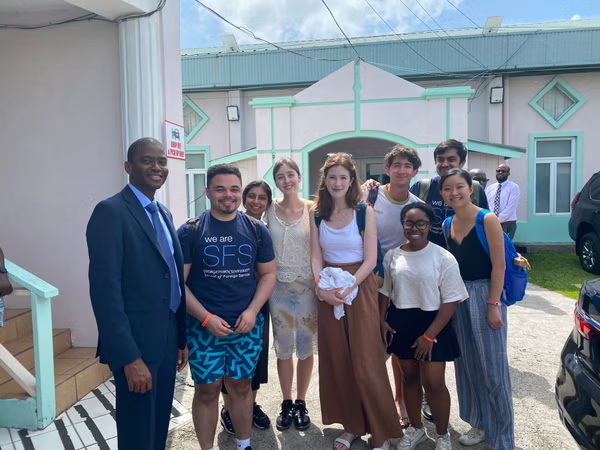
Fiona Naughton (SFS’26) has had a busy career at Georgetown, balancing an exploratory academic journey with a series of meaningful extracurricular contributions to labor activism both on- and off-campus. As graduation approaches, Naughton looks back on her time at SFS, highlighting the importance of creating community, standing up for the causes that matter and staying true to her values and goals.
Finding an academic focus
Over the course of her time at Georgetown, Naughton cast a wide academic net, exploring various SFS disciplines before landing on a major in culture and politics, concentrating on international labor policy, with a double minor in English and French. Naughton explains that she was driven to switch majors after finding herself “deeply impressed by the critical perspective that CULP majors had on the world.”
“Every CULP major I interacted with sought to understand a situation with respect for material and historical factors, within an interdisciplinary lens. I knew that if I wanted to be like them, I should probably major in culture and politics, too,” she says.
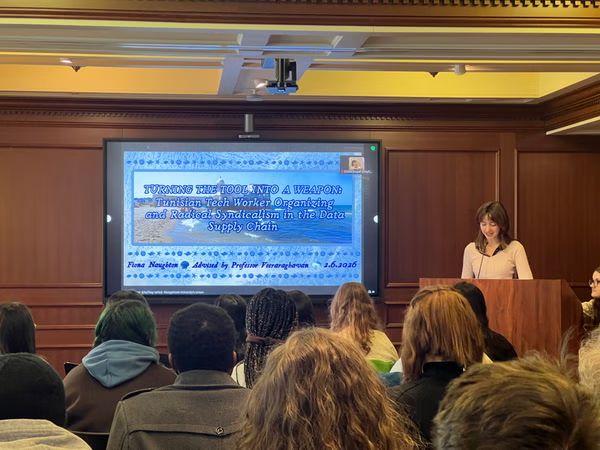
Within the CULP curriculum, two classes stand out as particularly impactful: Modernist Literatures with Professor Nicole Rizzuto and Global History of Worker Self-Activity with postdoctoral fellow Jack Davies.
Modernist Literatures “completely altered my understanding of life and of the literary form,” Naughton recalls. “I gained a deeper understanding of time-discipline and industrial capitalism, of colonial and post-colonial literature, and of critical theory, notably discussing the connections between modernism and imperialism.”
Global History of Worker Self-Activity changed Naughton’s perspective in a similar way. She explains that she loved the course “because Davies taught my class what it means to study history from below, giving merit and agency to the working class throughout history.”
Labor activism rooted in Georgetown’s campus
Naughton’s on- and off-campus involvements have continued the focus on labor movements that she developed in the classroom. At Georgetown, Naughton is part of the Georgetown Coalition for Workers’ Rights, Students for Justice in Palestine, WGTB, the Kalmanovitz Initiative for Labor and the Working Poor, the Georgetown International Relations Club and Bossier, Georgetown’s feminist literary magazine. She is also a member of the 2024 cohort of the Laidlaw Scholars Program.
Naughton recalls one of her favorite Georgetown memories, the Labor Solidarity Concert organized by the Georgetown Coalition for Workers’ Rights and WGTB in September 2025.
“I have never felt a greater sense of community than in that moment, eating dinner and singing softly with GUTS drivers and professors and students I had never met before,” she says.
Off-campus, Naughton has interned for Starbucks Workers United, which represents Starbucks workers across the country, and for the Tunisian General Labour Union (UGTT), an opportunity that brought her to Tunisia for seven weeks.
Creating meaningful personal connections
Naughton highlights the relationships and connections she has formed at SFS as one of the most important aspects of her college experience.
“Within the SFS, I deeply value the relationships that I’ve formed in the culture and politics department,” she says. “Those relationships were fortified during the process of writing our senior theses—we depended on one another intimately and became extremely close in what was a very trying but very fulfilling intellectual journey.”
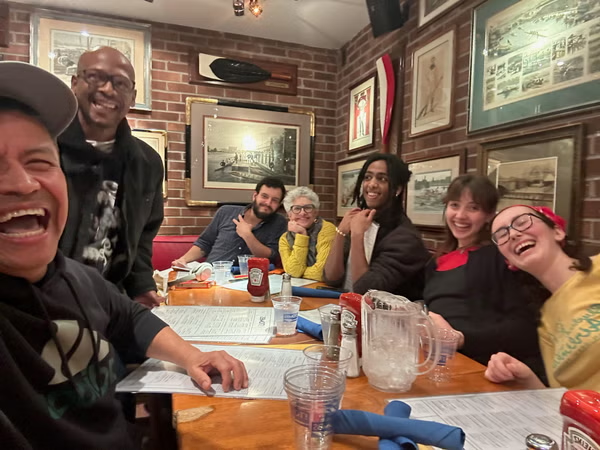
Naughton also credits the incredible faculty connections she formed at Georgetown, explaining that “my entire experience at Georgetown would be somewhat meaningless without my mentors and advisors.”
However, Naughton says that the relationships that have impacted her most are those she has formed with the workers of Georgetown, specifically the custodial staff and GUTS bus drivers. “Anything I have learned about organizing and building community and Georgetown as an institution, I have learned from them,” she explains.
Reflecting on the community she has built, Naughton says she wishes she could tell her first-year self to “put down roots on campus as soon as possible.” She says, “I would tell her to get to know intimately the minutia of the university, to steep herself in the details of daily life, to talk to anyone and to everyone.”
Naughton emphasizes the importance of viewing the college experience as valuable in and of itself, rather than looking at college as simply a career stepping stone.
“Georgetown is not just a transitory place for students to pass through, but a critical part of local and global economies, playing an important role in the production of material goods and of knowledge,” she says.
Bringing grassroots power to the future
As she prepares to leave SFS, Naughton says she will miss “the quintessential Georgetown moments, like the ability to see revolutionary figures like Angela Davis speak in Gaston Hall on a Monday morning.”
More importantly, though, Naughton highlights the Georgetown community.
“I will miss the community that I have been so lucky to be welcomed into—not just the community of a single academic department or age group, but the community forged through relationships of mutual dependence and care,” she says.
She adds that she will miss “my friends, my surrogate family in the Georgetown Coalition for Workers’ Rights and, most especially, the workers on campus who are the beating heart of the university—and who have given me hope in any sort of future.”
After graduation, Naughton plans to pursue a career as a middle or high school English teacher. She explains that her seventh-grade English teacher is “the reason that I ended up at Georgetown,” while affirming that her time at SFS exposed her to “the necessity of building power at the grassroots level.”
As she continues to explore and refine her professional pathway going forward, she keeps returning to something that Professor Mark Giordano told her class in her first week at Georgetown: “Any global injustice you wish to solve is also happening in your community.”