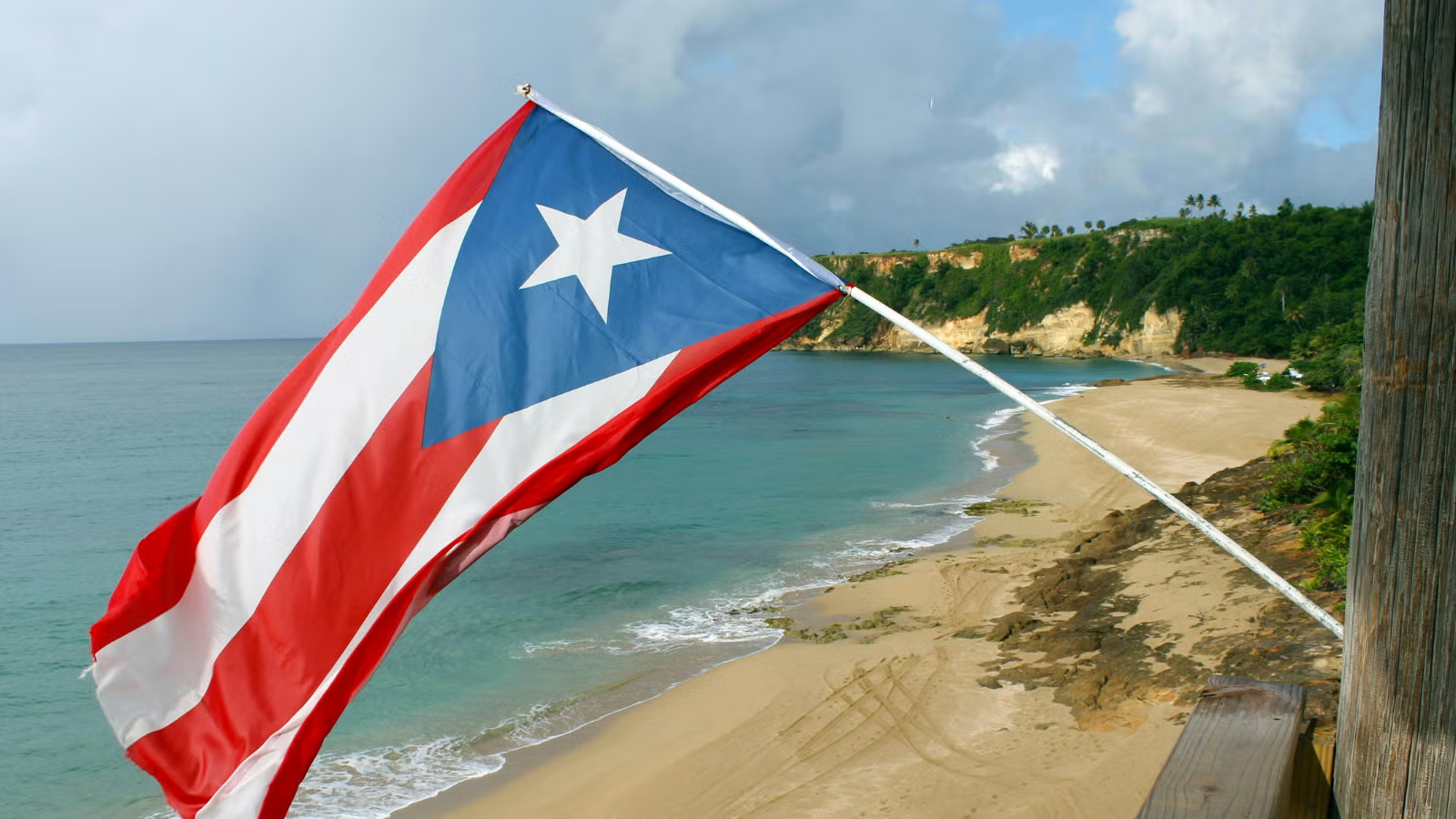
In a winter awash with heightened emotion over immigration in the United States—including the shootings of two U.S. citizens in Minneapolis, Minnesota, by U.S. federal agents and arrests by Immigration and Custom Enforcement (ICE) reaching almost 400,000 immigrants in the first year of the Trump Administration—Puerto Rican pop star Bad Bunny took to the Super Bowl stage to perform the halftime show. Bad Bunny was coming off his historic win of Album of the Year at the 2026 Grammy Award Ceremony as the first artist to win for a record sung entirely in Spanish. The conservative organization Turning Point USA was so opposed to his selection that they sponsored an alternative performance headlined by Kid Rock and other country stars. We spoke with Melinda González, assistant professor in the School of Foreign Service and Puerto Rican scholar and poet, to unpack Bad Bunny’s performance and what it means in the conversation about music as a form of political expression. González is currently teaching a class titled Bad Bunny, Poetry and Puerto Rico.

Q: People in the U.S. have listened to Spanish-language music for years, with artists like Daddy Yankee and Shakira as established figures in the mainstream. Why has Bad Bunny been able to break into the highest echelons of pop success, surpassing Spanish-language artists before him? What do you think contributed to his recent skyrocketing success, especially in this political climate?
A: As someone born and raised in the U.S. whose first language is Spanish, Spanish-language music has always been a part of that experience for me. Caribbean people have been essential in the development of multiple musical styles, including hip hop, created through collaborations by African American and Caribbean artists from Jamaica, the West Indies and Puerto Rico, amongst other groups living in the South Bronx. And salsa music was actually a Nuyorican [New York-Puerto Rican] collaboration. It’s not so much that Spanish-language music is just arriving into the mainstream, because Latin American and Caribbean artists have always been a part of it. I think it’s more about how this particular moment is allowing for these artists to maintain their authentic sound without assimilating to English-language airwaves to share their music with the world.
I grew up listening to influential artists like Marc Anthony, La India, Ricky Martin, Gloria Estefan, Celia Cruz and La Lupe when our music only came from radio air waves. Some of these artists, alongside people like Shakira, were able to cut into the mainstream decades ago when they began to release English-language songs.
Daddy Yankee’s 2004 release of “Gasolina” broke genres like reggaeton into the mainstream U.S. market, partly because of its repetitive chorus using a commonly used and known word. But Daddy Yankee had already been a household name in Latin America and the Caribbean long before people became aware of him in the U.S. While many unfamiliar with the genre might consider Daddy Yankee as one of the fathers of reggaeton, the genre predates him by decades and was founded by Afro-Latino artists, who’ve not received the recognition or mainstream attention their lighter-skinned counterparts have enjoyed.
As far as Bad Bunny, I wouldn’t describe Bad Bunny’s success as “recent.” He’s been an important cultural icon for Puerto Rican people since at least 2018. His global success can be partly attributed to the changing landscape of how we consume and learn of new music in a technological age marked by Spotify, Soundcloud, Youtube Music and online streaming in general. Music is no longer held captive by radio airwaves, and people have a choice of what to consume. This choice allows people to pursue music that is influential in other regions of the world.
He, like his predecessors, did collaborate with English-speaking artists to break into the mainstream, such as Cardi B and J Balvin (“I Like It”) and Drake (“Mia”). His breakout solo song, however, came in the aftermath of one of the worst ecological disasters to strike Puerto Rico, Hurricane Maria, with his release of “Estamos Bien,” a ballad that affirmed hope in the face of governmental neglect, mass death and displacement, a tribute that affirmed that Puerto Ricans are still alive and working towards their recovery with each other. His recent catapult to mainstream attention comes in a larger context of global awareness of the crises that Puerto Ricans at-large are confronting as Puerto Rico remains a colony of the United States, facing multilayered forms of colonial violence.
Q: Bad Bunny’s advocacy for political issues affecting Puerto Rico is an important aspect of his music. How would you characterize the political dimensions of his work? What distinguishes his approach from other artists who have addressed Puerto Rican politics?
Bad Bunny’s music rose to notoriety in the aftermath of Hurricane Maria (2017). His early albums were a combination of trap, rap and hip hop mixed with Puerto Rican rhythms. The songs were joyful expressions typical of these genres, focused on dancing, enjoying life and romantic exploits. Some, including myself, argue that joy in the face of colonial repression can be a form of resistance that affirms life in the constant face of death and displacement, especially when you consider the perreo combativos, which were part of the 2019 Ricky Renuncia protests that mobilized the entirety of the Puerto Rican population. At the height of that political mobilization, Bad Bunny collaborated with Residente (formerly of Calle 13) and iLe, to release the track titled “Afilando los cuchillos” (“sharpening knives”). The song borrowed from the hip hop genre of diss tracks and addressed then-governor Ricardo Rosselló and Telegramgate, the release of chats the governor had with cabinet members alleging corruption and poking fun at the mass death and suffering that occurred in the months and years after Maria. Studies suggest that the death toll was anywhere between 4,000 to 12,000, depending on how you count the impacts of the hurricane, the electrical failures that ensued and the lack of access to clean water, food and medical care. Bad Bunny’s lyrical additions to the song speak to a lack of hope for the future of Puerto Rican youth, which we see him platforming in this current moment.
In 2020, he released “Compositor Del Año,” a track that hasn’t received the same level of renown but is also addressing political corruption, racism and colonial violence in Puerto Rico. In the video for “SI VEO A TU MAMÁ” from the album YHLQMDLG, released in 2020, we see a young Puerto Rican man staring at a rope contemplating suicide. Suicide rates in Puerto Rico increased drastically in the aftermath of the hurricane and in the face of the Puerto Rico Oversight, Management, and Economic Stability Act, (PROMESA), ongoing austerity measures implemented by the Obama administration. That same year, he was a guest artist on The Tonight Show, where he performed the track “Ignorantes” with Sech. He wore a shirt that said “MATARON A ALEXA” in large red letters, with black letters below that read “NO A UN HOMBRE CON FALDA” (“They killed Alexa, not a man in a skirt”), a reference to the murder of a young transwoman in Puerto Rico, who was repeatedly called a man in Puerto Rican media. From his early days in the industry, through his use of style and fashion and speaking on the murders of transpeople, Bad Bunny has platformed the experiences of marginalized Puerto Ricans and critiques the treatment of queer and trans people in Puerto Rico.
Bad Bunny continues a long-standing critique of colonialism and violence in Puerto Rico at the hands of the United States, the local government, austerity measures, racism and the impacts of displacement.
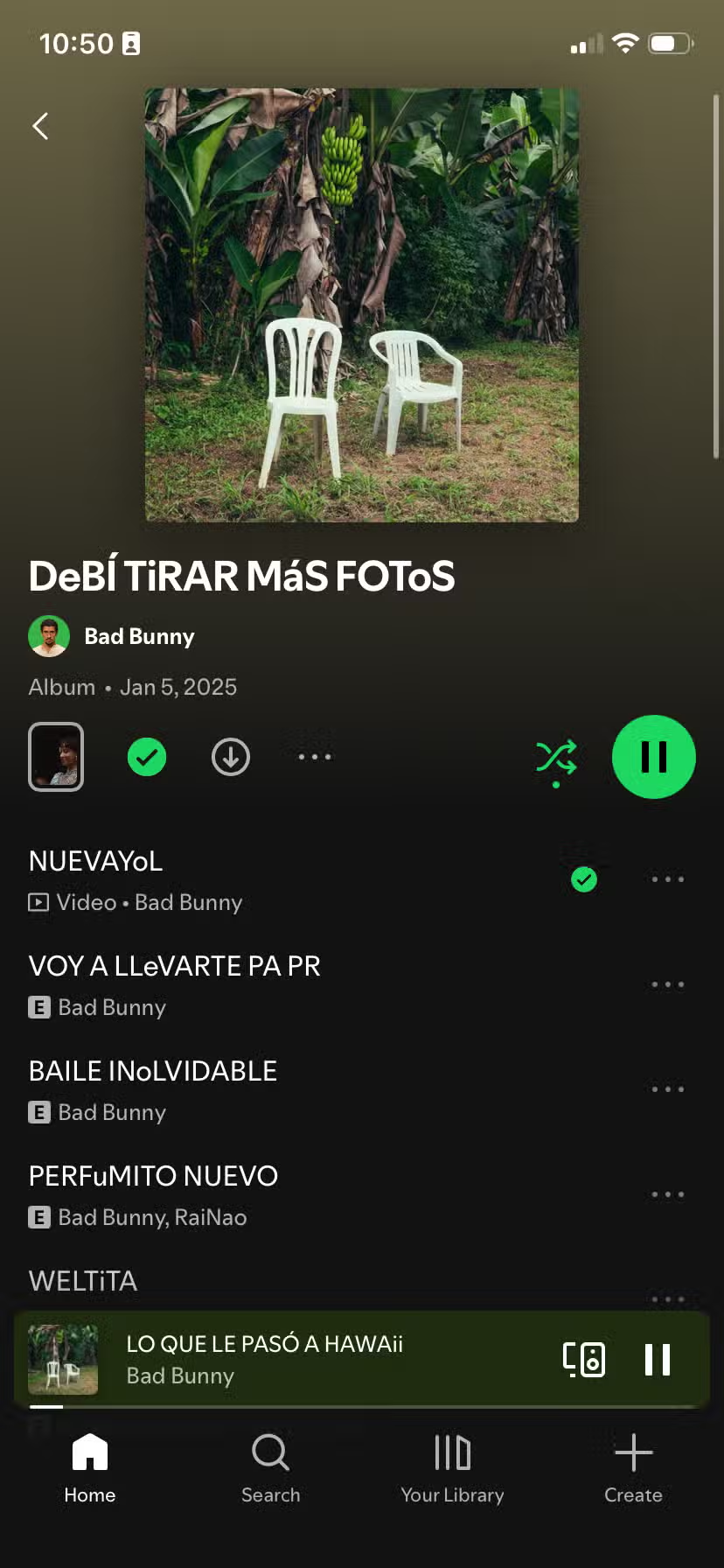
His 2025 album, DtMF, was received as a gift to Puerto Ricans for Dia de Los Reyes, the gift-giving holiday for Puerto Ricans that marks the close of the Christmas season. As an anthropologist that was deep into the throes of writing my book manuscript on cross-diasporic displacements in the aftermaths of Hurricane Maria and PROMESA, I was pleasantly surprised to discover that the layout of the album paralleled the way my book manuscript was written, starting with the diaspora and ending with people’s refusal to leave the archipelago. To Puerto Ricans both on the archipelago and the diaspora, the album felt like a love letter to us, celebrating the multi-layered sounds of Puerto Rican music from bomba to plena to salsa to hip hop to reggaeton. Each song layered a part of our history—diaspora realities, forced displacement, fear of losing our culture and refusal to abandon our connections to our motherland. Following it with a residency that declared, “I don’t want to leave here” that was open to only archipelago-wide residents for the first few shows and ending with the same also marked an important political statement—that it was for Puerto Ricans by Puerto Ricans. Of course, Bad Bunny’s music is not always received with full acceptance, and his collaborations with particular artists, producers and brands have received criticism for reifying the very colonial and violent structures his latest album purports to critique, including his collaboration with Amazon and his long-standing silence on Palestine.
Q: In his Super Bowl performance, Bad Bunny featured songs like “LO QUE LE PASÓ A HAWAii” and “El Apagón,” as well as imagery of sugar cane fields and la casita. What is the significance of his use of these songs and images in an event with such a large and diverse audience, and what does that tell us about the intersection of sports, popular culture and politics?

A: Having attended Bad Bunny’s residency in Puerto Rico due to a generous grant from the Center for Latin American Studies, I was able to have first-hand experience of his performances for DtMF. In the concert, he often featured a special guest to perform “LO QUE LE PASÓ A HAWAii.” Having Ricky Martin, one of the first Puerto Ricans to break into mainstream music through assimilating to the English-language, was very powerful to me. I see “LO QUE LE PASÓ A HAWAii” as a song that resists assimilation and further colonization. It’s a warning to Puerto Ricans that statehood is not going to spell out freedom or an improvement in our conditions. I would probably change the name of the song to “LO QUE LE ESTA PASANDO A HAWAii,” because the colonization of Hawai’i and the violence that is happening to Kanaka Maoli is ongoing as their lands continue being appropriated and their culture is used by the tourism industry. I felt like Ricky Martin singing the song was almost a way to de-assimilate him, and that is powerful in a particular political moment that punishes the use of non-English.
“El Apagón” was released as both a song and a documentary, with independent journalist Bianca Graulau providing coverage on the rising displacement and disenfranchisement of Puerto Ricans on the archipelago. In my class, we discussed how much more powerful playing this song would have been if it were nighttime in California during the Super Bowl, because in the concert, all of the lights went off, and the audience was in darkness. It would have sent a stronger message for all of the stadium to have gone dark the way Puerto Rico often does as a result of the failed infrastructure that LUMA Energy fails to remedy.
From the sugar cane fields, which hint towards the colonization of Puerto Rico and the brutal realities of early colonialism, to the industrialization of the archipelago by the United States, the performance hinted at these important moments that have shaped Puerto Rican life. More powerful for me than these moments was the moment that Bad Bunny performs “Nuevayol.” Just as the title of the song is spoken, he does a trust fall into the dancers meant to represent the diaspora. For me, this moment symbolizes the way that Puerto Ricans face displacement without knowing what will happen. In my research, post-Maria and PROMESA displacement led to more difficult experiences for Puerto Ricans and new forms of violence as disaster agencies failed to help them secure stable housing and work due to ongoing gentrification of Nuyorican neighborhoods and communities. It also symbolized for me the ongoing relationship between the diaspora and Puerto Rico as a continuum that relies on each other for the survival of the Puerto Rican people as we face threats to remaining connected to our home and culture.
Like the concert in Puerto Rico and later installments, what’s powerful about Bad Bunny is how he remains rooted in Puerto Rican sounds, culture and aesthetics. That can also be problematic as corporations work towards capitalizing on his fame to create products that use these very sacred cultural icons as fashion statements. No Puerto Rican I know wants to see the pava being used by random fashion brands at some random fashion week, for example.
Sports and popular culture have always been political. What bodies entertain versus what bodies own the teams and the means to broadcast have always been embedded in legacies of empire.
Q: Bad Bunny’s Super Bowl performance came after his historic Album of the Year win at the Grammys, during which he publicly made statements against ICE and hatred towards immigrants. In addition, his Super Bowl performance was centered on love over hate and featured queer couples, a real wedding and a celebration of all countries in the Americas. What do you see as significant about this moment? How do you situate Bad Bunny within current conversations about music as a form of political expression?
A: ICE has been a persistent threat to immigrants in the U.S. since its inception. When Bad Bunny released the music video for “Nuevayol” on July 4, 2025, the video featured a generated Trump voice that spoke the words, “I made a mistake. I want to apologize to the immigrants in America. I mean the United States. I know America is the whole continent.” So, Bad Bunny speaking out against Trump’s anti-immigrant policies is not a new phenomenon. It’s consistent with his larger messaging against displacement, the colonization of his homeland and government corruption at large. Bad Bunny has often featured queer aesthetics in his performances and has been an advocate for trans lives. What’s significant now is the stage in which this is taking place. Following Kendrick Lamar’s 2025 performance, which highlighted the contributions of Black Americans to the larger fabric of U.S. society, Bad Bunny is providing a similar message of the contributions of Puerto Ricans and other Latin American and Caribbean people.
It behooves us to remember that the Super Bowl’s capacity for revolutionary messaging is limited, however. While Bad Bunny makes music and addresses important issues, it’s important that we don’t confuse him with a revolutionary. Music is and has always been inherently political. Choosing not to engage in what’s happening in the world around you is also a political choice. But for some artists, the stakes are different.
When Bad Bunny says, “God Bless America” at the Super Bowl, he follows it by naming the flags of what makes up the American continent, the United States being a part of that. This moment pushes the discourse towards an acknowledgement that the U.S. is only one part of this hemisphere and not the center of it.
Q: How do you study Bad Bunny, culture and politics in your class? Why do you think he’s an artist worth studying at this moment? How are students engaged in the classroom?
A: I was hired at Georgetown’s SFS as a scholar of climate change, displacement and decolonization. My scholarship is rooted at these intersections, but also I am a poet and writer deeply rooted in the Nuyorican and Black Arts poetic traditions. In my scholarly research and poetic writings, I have always been interested in the role that poets, musicians and artists play in shaping counter-narratives to the state, how they have resisted, mobilized social movements and engaged in disaster recovery to address increased environmental risks. For me, the role of the artist has always been central in understanding how communities engage in practices of survivance.
As a scholar of Puerto Rican descent whose research explores how environmental disasters intersect with race, class, gender and colonialism, with a focus on Puerto Rico and its diaspora, I wanted to teach courses that use decolonial and Indigenous methods to teach how communities across Latin America and the Caribbean navigate displacement and organize in the aftermath of catastrophe.
When Bad Bunny’s album came out, and I realized its parallels with my book manuscript, which traces the multiple scales of Puerto Rican displacement while highlighting everyday practices of resistance and survivance, I joked around with my colleague that I should teach a course on Bad Bunny. And that joke quickly became a reality when I was set to teach a freshman Proseminar for the fall 2025 semester. I decided to name the class Bad Bunny, Poetry, and Puerto Rico. I am teaching the course again, this spring 2026, with mostly second semester seniors.
I joke with my students that I use Bad Bunny’s name to get them to sign up for the class, but once they do, what they’re really going to learn is about the long-history of Puerto Rican resistance that Bad Bunny hints toward. The course uses about 12 of his songs to frame the theme for each week. I use his music as an entry point into the themes and topics.
For example, on the week where we center the song “LO QUE LE PASÓ A HAWAii,” students learn about the colonization and illegal occupation of Hawai’i; the current struggle for independence by Kanaka Maoli (Native Hawaiians) and the migration of Puerto Ricans to Hawai’i as a result of Hurricane San Ciriaco (1899); and about existing Puerto Rican diasporas in Hawai’i, who’ve created their own musical forms and traditions. In the week that we discuss “Nuevayol,” students learn about the development and creation of salsa music and the cultural fusions between Nuyoricans and Puerto Ricans.
In the week that we discuss “DtMF,” we talk about displacement and gentrification in Puerto Rico and its diasporas and highlight the way this song was mobilized by Palestinians, especially in Gaza. We discuss what it might mean that Bad Bunny has remained silent on the genocide in Palestine.
Through his music, we talk about the intersections of colonialism, austerity, revolution and the limitations of entertainment in resistance on a global scale, as well as the possibilities for cross-movement solidarity amongst colonized people around the globe. We also invite guest speakers to Zoom in and talk with students, including Libre X. Sankara, an Afro-Boricua poet doing humanitarian work in Gaza; Dmitri Reyes, a Puerto Rican poet from Newark, New Jersey; and Ana Portnoy Brimmer, a Puerto Rican poet of Mexican-Jewish descent raised in Puerto Rico. Bringing artists to speak with the students also helps them to see the real world applications of the arts in global solidarity and resistance movements.
The Proseminar concluded with students using the themes of the course to present creative projects they conducted throughout the semester, tying the themes of the course to the colonization of India, the Armenian genocide and their own struggles of being displaced and away from their families. We also ate Puerto Rican food together on our last day and danced to Bad Bunny’s music.