
The word “pogrom” means to wreck havoc; to demolish violently. Russian in etymology, it’s historically referred to violent attacks by non-Jewish populations on Jews in the Russian Empire and, later, in other countries including Nazi Germany.
Now, an Georgetown scholar has taken the word and its underlying concept—violence against a minority group by a dominant group—and applied it to U.S. history in a book simply titled American Pogroms. Written by SFS and government department professor Daniel Byman, the book includes close examinations of many shameful events in U.S. history, including discrete acts of violence, usually state-sanctioned, over two centuries against Mormons, Catholics, Chinese immigrants and Black Americans. We spoke with Professor Byman to learn more about his book, which was published on July 1, just in time for America’s 250th anniversary.
Q. In reading the book, it seems that this topic is important to you personally as well as professionally. Is that true, and if so, why did you feel it was important to write about the central idea of American Pogroms?
A. Both personal and professional reasons led me to write American Pogroms. Like many Americans, I come from a family of immigrants. For my grandparents and great grandparents, popular violence against Jews in Russia and what is now Ukraine was a constant threat and part of why they came to the United States to seek a better life. So the concept of a pogrom was something I learned about when I was young and has stayed with me.
Most of my career has focused on studying political violence. However, most of my research focused on other parts of the world such as the Middle East and Europe. In recent years, I began to focus more on terrorism in the United States. Although I addressed more current violence in my previous book, Spreading Hate: The Global Rise of White Supremacist Terrorism, my research led me to learn about past incidents of violence about which I knew little. Thus, I realized that I often had more knowledge of the history of terrorist groups like Hamas or Hizballah than I did of the antecedents of some violent movements in the United States.
My new book is my attempt to apply ideas I learned from my family history to American history, bringing to the subject my knowledge of terrorism, insurgency and other forms of political violence. It was also a way of educating myself, learning about the history of my own country, including places I’ve lived, about which I was ignorant.

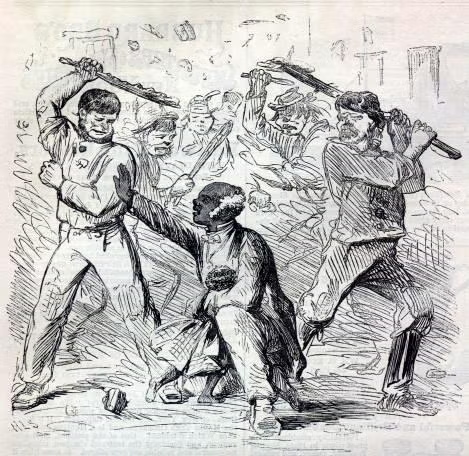
Q. One of the themes that emerges in your book is that while pogroms are perpetrated by a dominant group against a minority group, the identity of the dominant group in the U.S. was under constant evolution throughout the nineteenth century as the definition of who is considered “white” gradually expanded. How are we to understand the use of the term “pogrom” when applied to a case in which one non-dominant minority group attacks another even less-dominant minority group—such as the 1863 New York City Draft Riots in which Irish Catholics attacked Black Americans? How did elites manipulate the class and race tensions?
A. The term “pogrom” is slippery, and one of the depressing realities I learned in my research is that minorities rarely band together. Indeed, it is far more common for one oppressed group to join in scorning another. Lewis Charles Levin, the second Jewish member of Congress, was a leader of anti-Catholic violence; Rebecca Latimore Felton, a prominent suffragette (and, technically, the first woman to serve in the U.S. Senate when she was appointed to fill her husband’s position for a day) gave a blood-curdling speech calling for lynching; and Irish labor leaders championed the expulsion of the Chinese, among many examples.
As your question indicates, the Draft Riots case is one of relative privilege (or lack thereof); the Irish were horribly mistreated in New York and elsewhere, but they were still better off than Black Americans. In New York, leaders of the Democratic Party manipulated Irish resentment of the draft and played up racism in order to discredit their Republican opponents. However, the violence slipped out of the leaders’ control and ended up destroying parts of the city. We saw this pattern elsewhere: elite manipulation succeeded, but the mob itself often caused more damage than the leaders intended.
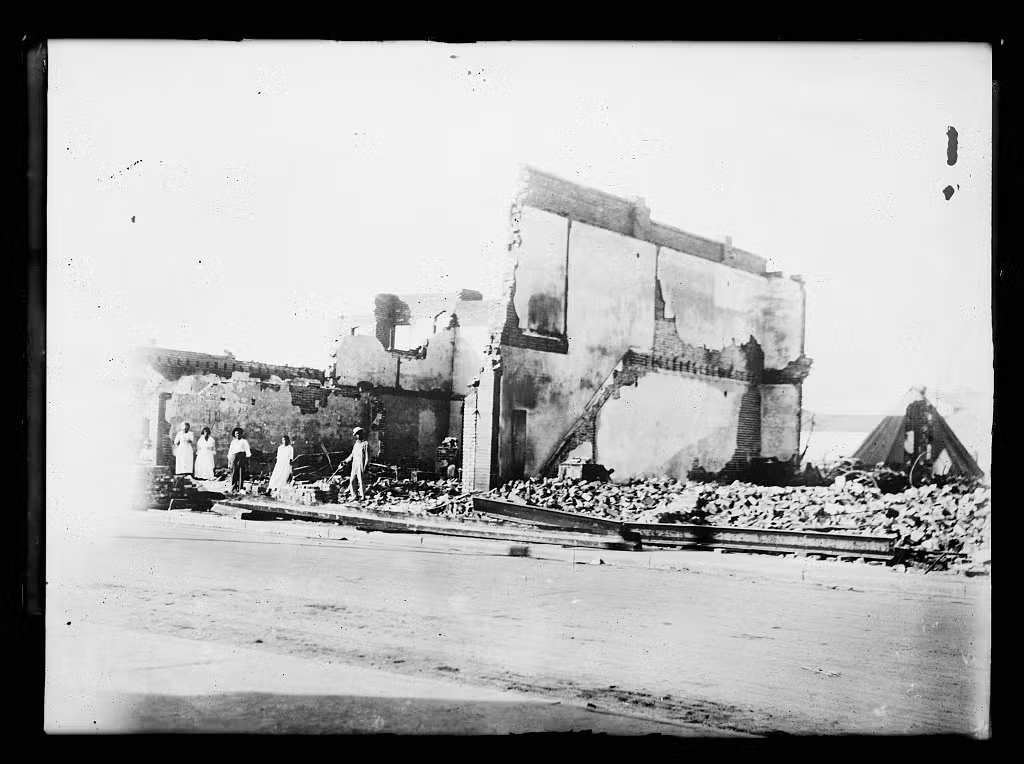
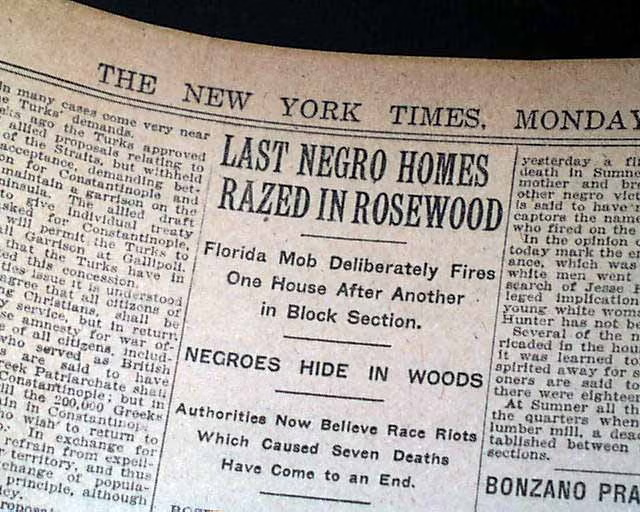
Q. Events like the 1921 Tulsa Massacre and the 1923 Rosewood Massacre were categorized at the time as “race riots.” How does applying the term “pogrom,” with its connotations of targeted ethnic destruction, community erasure and state tolerance, shift our understanding of accountability compared to the more neutral, two-sided framing implied by “riot”?
A. “Riot” has an implication of uprising, where the minority group “began” the conflict and is otherwise responsible for instigating and continuing the violence. For Rosewood, Tulsa and other instances I examine in my book, the violence is often started by the majority community, and in any event, it is highly one sided. Over time, as the 20th century continued, we started to see more two-sided violence, with minority communities often inflicting many casualties as well as suffering many of their own.
Q. One element pogroms have in common is some degree of state or other authority sanction. In what ways did the legal framework of Jim Crow ensure that perpetrators faced no judicial consequences?
A. One of the depressing lessons of this period is that violence works. Police at times joined the violence, often as individuals rather than the force as a whole, and at the very least, they were reluctant to arrest members of the mob. Most prosecutors would not indict, and few juries would convict. An early case of anti-Catholic violence I examine is the 1834 burning of the Ursuline convent in Boston. One of the perpetrators is clear that the evidence against him was overwhelming, but the defense argued that Catholic witnesses were inherently untrustworthy—similar arguments would be used to discredit the testimony of Black, ethnic Mexican and Chinese victims, among others.

The perpetrators not only get away with violence, but they often prosper. Most continued their lives as respected local citizens. Some went on to higher office, whether at the local and state levels or even national level.
Jim Crow codified the discrimination, making social custom—e.g., that Black Americans must show deference to whites by stepping aside on the sidewalk—the law. This meant that police and government officials, not mobs, would be the ones to enforce discrimination.
Q. In your book, you write: “I wish I found that hatred, bloodshed, and evil do not pay, but the historical record, to me at least, makes clear that they do.” How should a younger generation of protesters, perhaps responding to different types of dominant community mob violence like the January 6 Capitol riots, understand that while not being discouraged?
A. As depressing as the research for my book was, I also found it uplifting that many things are better. Support for racial intermarriage (the ultimate bugaboo for racists), toleration of other religions in the public sphere, political representation of a range of minority groups, media reporting on violence and discrimination and many other things are far better than they were a hundred years ago. This does not mean there is no risk of violence, but the progress is real.
A younger generation—and those of us who are older, too—should be trying to further this progress, working to reduce discrimination for all communities and otherwise help Americans move closer to their ideals. Anti-immigrant sentiment, racial bigotry and other problems are longstanding, and if we recognize that they affected almost every American community, we should have more empathy for our fellow Americans today and can better work together as one nation.
Header image: Destruction from the 1921 Tulsa race massacre, June 1, 1921, United States Library of Congress. Public domain, via Wikimedia Commons