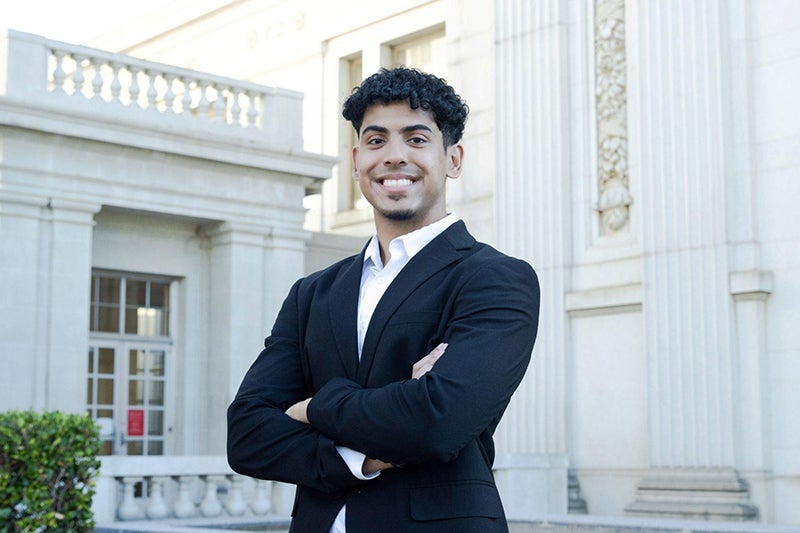
Muhammed Bakr
Global Human Development Student
Born and raised in Gaborone, Botswana and of Egyptian and South African descent, Muhammed Bakr is an aspiring development practitioner with a focus on finding the balance between data-driven insight and empowering local lived experience. He holds a B.A. in Economics with minors in Data Science and Global Poverty & Practice from the University of California,
Berkeley, where he was supported by the Government of Botswana Top Achievers Scholarship
— a full-ride merit award granted to fewer than 80 students annually from a pool of over 50,000.
During his undergraduate years, Muhammed built a broad consulting portfolio through Net Impact Berkeley, where he served as an Associate Consultant, Project Manager and eventually
President. As a Contract Consultant for the World Bank's Global Water Security & Sanitation Partnership in the Pacific Islands Region, he developed a least-cost design for rainwater harvesting infrastructure to meet UNICEF standards, adapted an engineering model to translate that design’s projected rainwater harvesting gains into DALYs averted and did a complete audit of water, sanitation and hygiene spending in Papua New Guinea, in order to place the proposed investment into context. He also led projects for the Global Alliance for Improved Nutrition (EatSafe), evaluating foodborne-pathogen testing solutions for traditional markets in Nigeria, Ethiopia, and Bangladesh; for the Environmental Defense Fund, applying econometric analysis to wildfire resilience programming; and interned for a boutique sustainability consulting firm, developing decarbonization roadmaps for large industrial clients.
Through the GHD program, Muhammed hopes to deepen his understanding of the ethical and efficacious trade-offs of different development approaches and the structural constraints shaping service delivery in low-income contexts, but more fundamentally, to interrogate the asymmetries of power and accountability that have long defined the relationship between donor institutions and the communities they claim to serve. After graduating, he plans to return to southern Africa to work on the development challenges closest to home, hoping to rethink paradigms around what development is and who it serves, in order to contribute to a more honest, reciprocal vision of what poverty-alleviation interventions can be.
In his personal life, Muhammed is a passionate footballer who plays and follows the game closely, a committed supporter of Liverpool FC, and a huge fan of film and TV that interrogates human society and political economy (e.g, Severance).