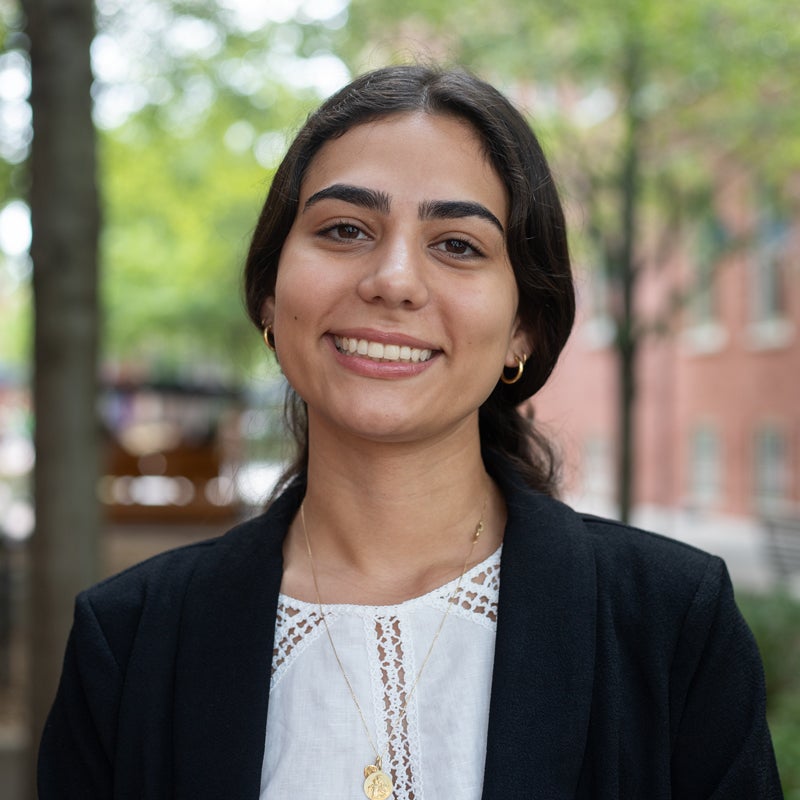
Maria Hernandez Pinto
Global Human Development Student
Maria Hernandez Pinto is an international development practitioner dedicated to promoting sustainable and community-led development, with a growing specialization in data-driven, evidence-based approaches to policy and program design.
Before joining Georgetown, Maria worked at several non-profit organizations addressing issues at the intersection of migration, gender, and labor rights. At the Labor Council for Latin American Advancement, an AFL-CIO constituency group, she developed "know-your-rights" toolkits, supported congressional labor advocacy delegations, and coordinated a leadership fellowship for Latin American union activists. At the California Domestic Workers Coalition, Maria designed worker testimony-centered communications materials for a legislative campaign aimed at securing health and safety protections for domestic workers. She presented her report on domestic worker health and safety at the 2021 American Public Health Association Conference. At DC Affordable Law Firm Maria conducted trauma-informed interviews and collaborated with partner organizations to facilitate access to free legal services for refugee youth and survivors of gender-based violence in the DC area.
Maria has also contributed to good governance initiatives in Colombia and the United States, including tracking financial disclosures at Citizens for Responsibility and Ethics in Washington and supporting infrastructure transparency efforts with local Juntas de Acción Comunal in Colombia.
Maria speaks English, Spanish, and Portuguese. She received a Bachelor of Arts in Political Studies and Foreign Languages from Pitzer College in 2022. Maria holds Colombian and Guatemalan citizenship.
Summer Internship
This summer, I interned with the International Organization for Migration (IOM) in Maputo, Mozambique. I worked under the Monitoring and Evaluation Officer within the Programme Support Unit. My work centered on strengthening the quality and reliability of the project's monitoring and evaluation systems. I helped identify and correct recurring data quality issues and validated datasets for an OCHA-funded humanitarian project. Beyond monitoring and evaluation, I compiled and cross-validated financial and programmatic data across OCHA's Financial Tracking Service and UNDCO's UN INFO platform, supporting interagency efforts to identify funding gaps and inform resource allocation decisions. This experience deepened my understanding of the operational realities of humanitarian data systems and reinforced the importance of accurate, well-communicated data in driving effective program response.