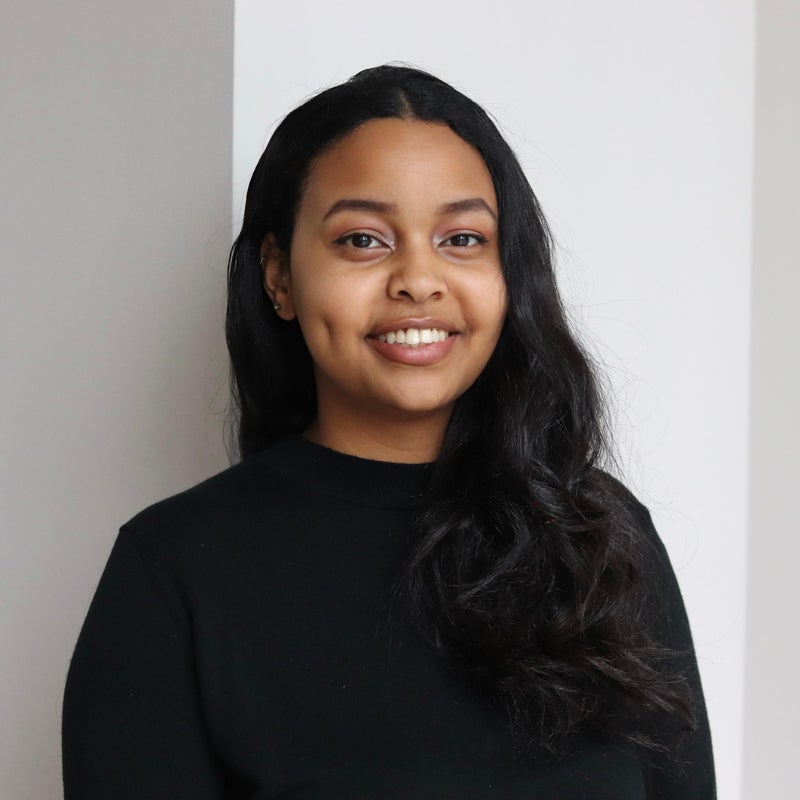
Abigail Mengistu
Global Human Development Student
Abigail Mengistu is a young professional with a strong interest in urban planning and socio-economic development in East Africa. Most recently, she served as an Associate Program Officer for the Africa team at the Center for International Private Enterprise (CIPE), where she worked on initiatives related to peacebuilding, business advocacy, and the economic empowerment of marginalized groups under the organization’s Ethiopia portfolio. Prior to CIPE, Abigail gained diverse experience as a training intern at the International Foundation for Electoral Systems (IFES) in Addis Ababa, a Housing Analyst at Associates for International Research, Inc. (AIRINC), and a research assistant at Rwanda’s National Commission for the Fight Against Genocide.
Abigail holds a Bachelor of Arts in International Affairs, with minors in African Studies and Urban Studies, from Northeastern University. During her undergraduate studies, she also participated in a summer program focused on urban justice in post-apartheid South Africa and studied abroad at the University of Cape Town. Abigail grew up in Addis Ababa, Ethiopia, she is currently based in Washington, D.C.
Summer Internship
This past summer, I interned at Impact Tank, a Namibian-Swiss social impact enterprise incubator and accelerator based in Windhoek, Namibia. Impact Tank’s work focuses on building sustainable, inclusive businesses that strengthen community livelihoods and local economies through entrepreneurship and community development.
As a Venture Building Intern, I conducted market research on business opportunities across Namibia's 87 conservancies. This work directly supported the Socioeconomic Development Fund under Namibia For Life - Africa's first Project Finance for Permanence (PFP) initiative. I was fortunate to see these research findings presented at a high-level donor meeting to help determine priority regions for program implementation. In addition to this, I identified gaps in training curricula on financial management, marketing and sales, operations, and governance and compliance for small and medium enterprises in rural areas, to create more targeted capacity-building support. I also supported Project 1000, a national initiative focused on equipping Namibian youth with digital skills and hands-on work experience, by analyzing participants' workforce readiness. Concurrent to my work on these projects, I contributed to internal strategy discussions around stakeholder engagement and mapped out activities to improve KPI tracking for the upcoming year.
This experience left me thinking about how financial structures can be improved to reach community-based enterprises. It deepened my interest in private sector development and how the public sector can better support economic growth. Building on this, I'll be joining the Landegger Program in International Business Diplomacy in my second year of the Global Human Development program to deepen my understanding of development finance and sharpen my technical financial skills.